

It’s 7:45 on a Friday night. A customer orders through your website, another orders through a delivery app, and a third walks in and orders at the counter. If those three orders land in three different places, someone on your team is manually retyping at least two of them into the kitchen queue, and that’s exactly where mistakes, delays, and missed items creep in.
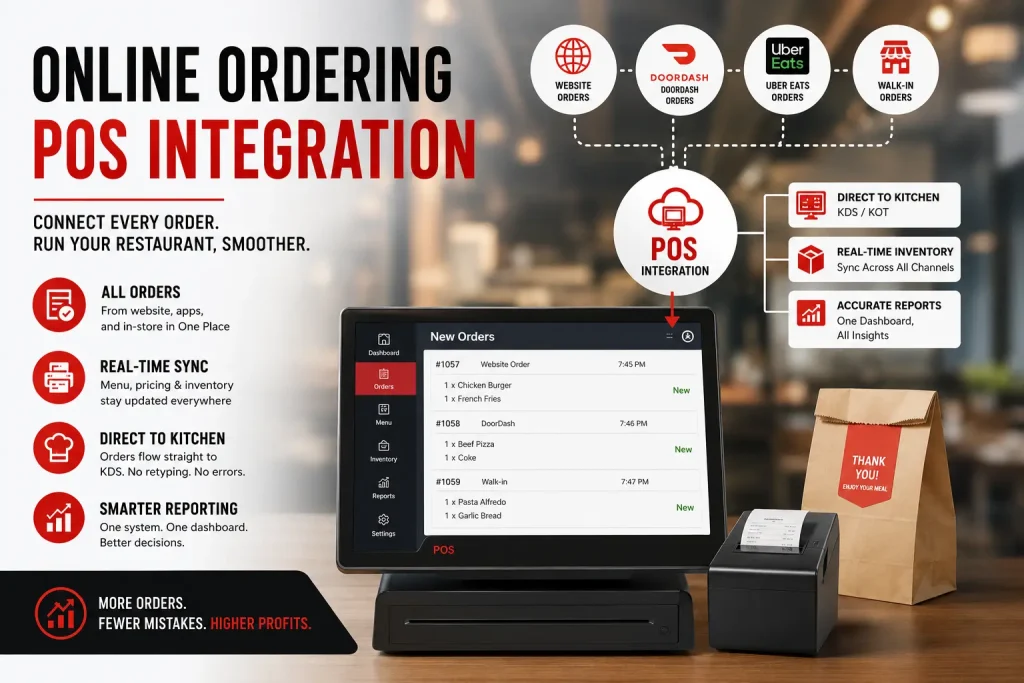
Online ordering POS integration is the fix for that. It’s the connection between wherever a customer places an order, from your website, app, delivery marketplace, or QR code table menu, and the point-of-sale system that actually runs your restaurant. Done right, every order shows up in one place, on one ticket, without anyone retyping a thing.
This blog covers what POS integration with an online ordering system actually means, how it works behind the scenes, what to look for in a system, and the questions restaurant owners ask most before making the switch.
What Does Online Ordering POS Integration Actually Mean?
In plain terms, it means your restaurant point of sale and your online ordering channels are connected through an API integration, so an order placed online doesn’t need a human to move it into the kitchen manually. It’s the difference between a tablet quietly buzzing with a new online order that a staff member has to read and retype and an order that prints straight onto the Kitchen Display System (KDS) the second it’s placed.
A true online ordering POS system handles this in both directions:
- Orders flow in from your website, app, or delivery marketplace straight into the POS order management queue
- Menu changes, price updates, and “sold out” items sync back out automatically; no more taking an item off the counter without remembering to remove it from three delivery apps too
Without that sync, restaurants end up doing what’s sometimes called “86ing” by hand, which means manually marking an item unavailable on every single channel separately, which is exactly the kind of task that gets forgotten during a busy shift.
How It Actually Works, Step by Step
Here’s roughly what happens behind the scenes with proper online ordering POS integration in place:
- A customer places an order through your website, app, or a delivery marketplace like DoorDash or Uber Eats.
- That order is translated through menu mapping, matching item names and modifiers so “no onions” means the same thing no matter which channel it came from.
- The order lands directly in your cloud-based POS, often as a kitchen order ticket (KOT) that prints or displays exactly like an in-house order.
- Kitchen staff prepare it using the same routing and timing logic as dine-in orders with no separate tablet to babysit.
- Payment, tax, and tip data sync automatically into POS sales tracking and reporting, so nothing needs reconciling by hand at closing.
- Inventory counts adjust in real time through the connected inventory management system, so stock levels stay accurate across every channel.
If a middleware or aggregator layer is involved, like the kind of software that sits between delivery marketplaces and your POS, this is also where order throttling can kick in. This automatically slows down incoming orders when the kitchen is at capacity instead of letting them pile up unnoticed.
Why This Matters More Than It Sounds Like It Should
It’s easy to treat this as a back-office detail, but the numbers say otherwise. A report found that 82% of consumers would order delivery more often, including 89% of millennials, if it were easier and more consistently available.
These numbers tell a simple story: demand for online ordering keeps growing. The restaurants capturing bigger checks from it are the ones where the order actually reaches the kitchen cleanly the first time. They are not the ones relying on a staff member to copy it over correctly during a rush.
What breaks without integration
- Manual order entry/re-entry: every retyped order is a chance for a wrong item, size, or address
- Inventory drift: stock looks available online after it’s already used
- No unified reporting: sales data scattered across five different dashboards instead of one
- Slower service: staff juggling multiple tablets instead of one ticket queue
Top Advantages of POS Integration with Online Ordering System
It’s easy to think of this as a back-of-house convenience, but understanding how online ordering POS integration improves restaurant operations means looking at marketing, service speed, staffing, and how customers feel about coming back. Here’s where the impact of a connected online ordering system with POS integration actually shows up.
Faster Order-to-Kitchen Speed
When an order doesn’t need a human to relay it, it hits the kitchen almost instantly. That matters twice over: food needs to stay hot on its way out the door, and a hungry customer waiting on a slow confirmation is far less likely to become a repeat one.
Stronger Mobile Ordering and App Performance
Most restaurant traffic today comes from a phone, not a desktop, so a smooth digital POS system connection to your mobile app matters more than ever. This is a big part of what people mean by a seamless online ordering experience. When the app, the website, and the POS are actually synced, reward points, personalised offers, and order status all stay accurate in real time, rather than being disconnected from what’s happening in the kitchen.
More Payment Options, Fewer Abandoned Carts
Customers expect to pay however they want, such as tap-to-pay, digital wallets, saved cards, etc., with the option to tip online built in. A connected payment gateway supports that flexibility, and PCI-compliant POS payment processing keeps it secure on every channel, not just at the counter.
Higher Customer Loyalty and Repeat Spend
Loyalty and rewards only work well when the POS, ordering platform, and customer loyalty program are actually talking to each other. This is one of the clearest benefits of online ordering POS integration for restaurants looking to boost repeat visits.
Fewer Manual Errors, Lower Staffing Risk
Restaurant and retail turnover is high, and new hires make more mistakes re-keying orders than experienced staff do. Automating that step instead of leaning on manual order entry/re-entry removes one of the most common sources of wrong items, missed modifiers, and refund disputes.
Real-Time Inventory and Menu Updates
Rather than updating stock, prices, and photos across five separate channels by hand, a connected restaurant POS with online ordering setup pushes changes out once and syncs everywhere. This is a core part of proper POS inventory management and one of the biggest time-savers for multi-channel menus.
Access to a Bigger Local Market
Every restaurant has a natural radius of hungry customers within a few miles, and most of them are ordering online whether or not your kitchen is set up to catch it. Full online ordering integration, including delivery-only setups, is also what makes the ghost kitchen and cloud kitchen model possible in the first place. This further lets a single kitchen serve a much wider restaurant technology-driven footprint than dine-in seating ever could.
A Less Stressed, More Productive Team
Cutting out repetitive manual data entry frees staff to focus on service instead of admin. Less friction behind the counter tends to show up directly in customer-facing moments. Shorter waits, fewer mistakes, and a better overall customer experience keep the average check size / average order value climbing over time. It’s a big reason more owners are searching for the best online ordering POS integration for small restaurants, not just enterprise chains.
Direct Ordering vs. Third-Party Marketplaces
A related question that comes up constantly: Should orders go through your own online ordering POS system or through marketplaces like DoorDash, Uber Eats, or Grubhub?
Third-party marketplaces bring visibility and new customers but typically charge commission fees in the 15–30% range per order. Most importantly, the marketplace usually owns the customer data, not you. That means no direct list to send a loyalty offer or a “we miss you” message to later.
Direct ordering through your own website or app, connected through a proper online ordering system with point of sale integration, keeps commission costs low and keeps customer data ownership with the restaurant. Most operators land somewhere in between, using marketplaces for discovery and reach while pushing repeat customers toward direct ordering, where margins are healthier. Here is the comparison of direct online ordering vs. third-party delivery apps or marketplaces.
| Factor | Direct Ordering (Website/App + POS) | Third-Party Marketplace (DoorDash, Uber Eats, etc.) |
| Commission per order | Low, flat fee or 2.5–3% payment processing | High, typically 15–30% |
| Customer data ownership | The restaurant owns it | Marketplace owns it |
| Discovery/new customers | Limited to your own marketing | Strong, app search and browse traffic |
| Loyalty & remarketing | Full control via CRM | Usually not possible |
| Menu & pricing control | Full control | Often limited by marketplace rules |
| POS integration depth | Deep, native order-to-kitchen sync | It depends on middleware/aggregator layer |
| Best for | Repeat customers, margin protection | New customer discovery, added reach |
Key Features to Look for in an Online Ordering POS System
Not every POS or restaurant management software claims the same level of integration. Here’s what actually separates a connected system from a patchwork of disconnected apps:
- Real-time menu sync: price changes and 86’d items update everywhere at once
- POS inventory management that adjusts automatically as online and in-store orders come in
- Kitchen Display System (KDS) support, so online orders route the same way as dine-in tickets
- POS payment processing built in, covering both in-person and online transactions
- Table Management and order-type handling for dine-in, pickup, and delivery (order-type triad) from one screen
- A Customer Relationship Management (CRM) layer that recognises repeat customers across channels
- POS reporting software with unified sales data instead of five separate exports
- Support for QR code ordering and white-label branded ordering pages
- Multi-location management if you run more than one outlet or a cloud kitchen
Common Mistakes Restaurants Make with Online Ordering POS Integration
Even restaurants that already have some kind of connection between their ordering channels and their POS often leave money and time on the table. A few patterns show up again and again:
- Treating every channel as its own island. Website orders sync, but delivery marketplace orders still land on a separate tablet that someone has to watch all shift. Half-finished online ordering POS integration is barely better than none. It just moves the manual work instead of removing it.
- Skipping menu mapping. An item named “Chicken Burger” on the website and “Chkn Brgr” on a delivery app might not match cleanly, which can cause pricing errors or missed modifiers at the worst possible moment.
- Not connecting loyalty and CRM data. If a customer’s order history only exists inside a delivery marketplace, there’s no way to recognize them, reward them, or win them back directly. The customer data ownership problem shows up here too.
- Ignoring reporting until tax season. Waiting until year-end to reconcile sales across five channels turns a five-minute report into a multi-day headache.
The fix for most of these isn’t more software bolted on top. It’s choosing one online ordering POS system that was actually built to handle every channel from day one, rather than stitching a POS, a delivery aggregator, and a separate online storefront together after the fact.
Getting Started: What Setup Looks Like
Connecting online ordering to your POS isn’t usually a full system overhaul. The general steps look like this:
- Audit your current order channels: website, app, marketplaces, QR codes, and note which ones already talk to your POS and which don’t
- Choose a POS with genuine integration, not just a bolt-on ordering widget that still requires manual entry
- Sync your menu once, centrally, so every channel pulls from the same source instead of five separate menu uploads
- Connect your Kitchen Display System (KDS) so tickets route consistently regardless of where the order came from
- Test with a small order batch before a busy shift, checking modifiers, taxes, and delivery-zone accuracy
- Review Real-Time Reporting after the first week to catch any channel still creating manual work
Final Thoughts
The restaurants pulling ahead right now aren’t necessarily the ones with the most ordering channels. They’re the ones where every channel actually connects to the same kitchen queue.
Online ordering POS integration turns a scattered set of tablets and apps into one operational system. This means fewer mistakes, faster service, and data you actually own instead of renting from a marketplace.
If you’re comparing options, this is exactly where Cherryberry RMS fits in. It’s built as a genuine online ordering and POS integration, connecting your website, app, and delivery channels straight into one POS, KDS, and inventory so orders never need retyping and nothing gets missed during a rush.
Common Questions About POS and Online Ordering Integration
Can a POS system manage online orders directly?
Yes, that’s the core function of a restaurant POS online ordering integration. Rather than online orders arriving on a separate tablet, they are routed into the same order queue as in-store orders.
Do orders from third-party delivery apps flow into the POS automatically?
With the right setup, yes, usually through a middleware or aggregator layer that translates marketplace orders into your POS format. Without that connection, staff are stuck manually re-entering each one.
Does online ordering POS integration actually increase average order value?
Yes, indirectly. When menu items, upsells, and modifiers are accurate and synced across every channel, customers order more confidently and add more to the cart. Restaurants tracking average order value alongside POS reporting typically see it climb once manual entry errors and mismatched menus are removed.
What are the benefits of a cloud POS system for online ordering?
A cloud POS means updates, reporting, and menu changes happen in real time from anywhere. It is useful for multi-location brands and typically integrates more easily with online ordering than older, on-premise-only systems.
Can a POS system integrate with my restaurant website?
Yes, most modern restaurant management systems offer native website ordering or an API integration that connects to your existing site, so orders placed there land straight in the kitchen queue.
Does online ordering POS integration sync menu and inventory updates in real time?
Yes. With a properly connected POS and online ordering system, menu availability, prices, and inventory changes can be synchronised across ordering channels. This reduces overselling, keeps sold-out items from being ordered, and helps staff maintain accurate stock levels.