

WhatsApp is already one of the most-used messaging apps on the planet, and people everywhere use it the same way: to get in touch with friends and family, ask about menus, confirm addresses, and check on their food. The problem is that most restaurants are still doing this manually, one message at a time, with one overworked staff member trying to keep up.
A WhatsApp chatbot for restaurant orders changes that completely. Instead of a person answering ‘what’s on the menu today?’ repeatedly, the bot answers instantly, in whatever language your customer base speaks.
In this blog, we’ll walk through exactly how an AI WhatsApp Chatbot for Food Ordering works, why it matters more than ever in 2026, what features actually move the needle, and how it stacks up against the phone-and-aggregator chaos most restaurants are still stuck in.
WhatsApp Ordering for Restaurants in 2026: Stop Losing Orders Every Night
The pattern shows up everywhere: whatever the local platform mix looks like, the phone line is still the bottleneck. A Restaurant Chatbot takes that bottleneck away by handling the repetitive questions and order-taking automatically, all day and all night, in whatever language your customer base speaks.
Here’s what tends to go wrong without automation:
- Missed calls during peak dinner hours mean missed orders, full stop.
- Staff spend hours manually confirming order details and payment methods that later fall through anyway.
- There’s no record of repeat customers, so loyalty and reorders are left entirely to chance.
- Holiday weekends and local events overwhelm phone lines exactly when order volume is highest.
Every WhatsApp bot vs food delivery apps comparison usually comes down to this. A WhatsApp flow handles the volume spike without adding headcount. Restaurants that adopt 24/7 order automation typically see fewer missed calls, and automated food ordering quietly replaces the old phone order era entirely. The restaurant keeps taking orders around the clock; the team just isn’t the bottleneck anymore.
Why Food Delivery Businesses Need WhatsApp Business API
This is where the technology actually comes from. The WhatsApp Business API, owned by Meta, is what allows a business account to connect to automation tools, send order confirmations, and get that trusted green tick verification badge customers recognise.
It’s different from the free WhatsApp Business app most small shops use. The API is built for volume: it can talk to hundreds of customers at once, integrate with your POS and CRM, and trigger automatic messages the moment an order status changes. In practice, it’s less a messaging tool and more a full customer engagement channel that happens to also take orders.
Why this matters for a restaurant specifically:
- Message open rates on WhatsApp are dramatically higher than SMS or email, which means order confirmations and delivery updates actually get seen.
- Customers already trust the channel. They’re not being asked to download a new app or create a new account.
- It supports digital ordering flows, catalog browsing, and even in-chat payments through WhatsApp Payments where available.
That open-rate gap is exactly why so many restaurants are treating WhatsApp less like an experiment and more like core infrastructure: it’s the one channel where an order confirmation or a delivery update is actually guaranteed to be seen, not buried in a promotions folder or missed between ringtones.
This is the real foundation of a WhatsApp AI agent for food ordering. Without the official API, you don’t get reliable mobile ordering automation, verified branding, or the scale to handle real order volume.
How a WhatsApp Restaurant Chatbot Works: Step-by-Step Order Flow
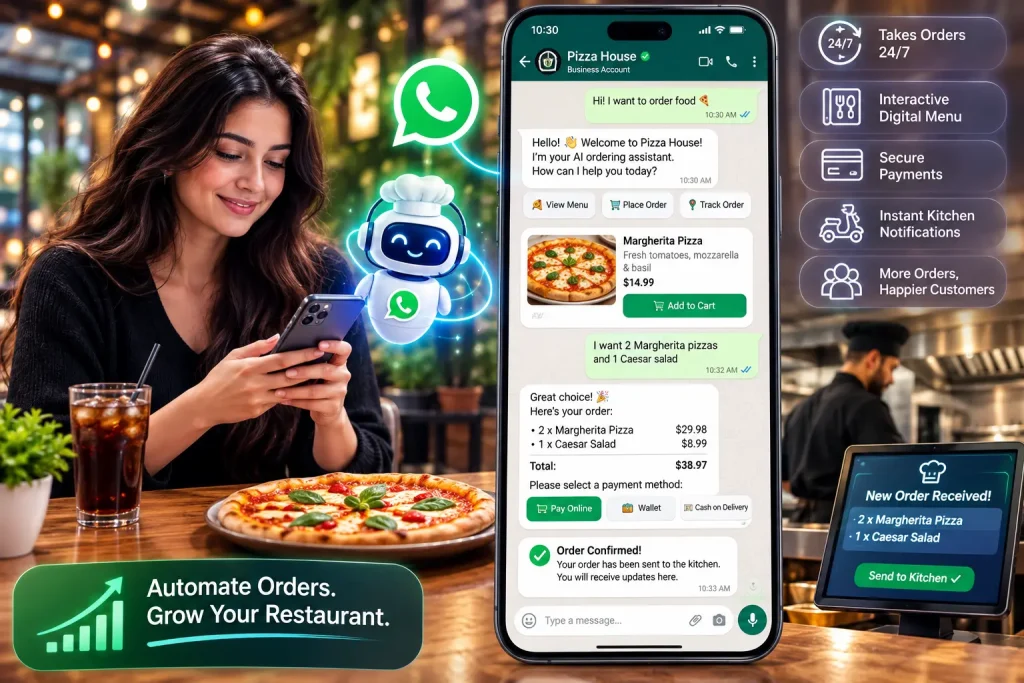
So what actually happens when a customer messages your restaurant for online ordering? Here’s a WhatsApp chatbot setup for a restaurant step-by-step walkthrough, and a plain answer to how an AI WhatsApp chatbot works for restaurants like yours, using a realistic example of an AI WhatsApp chatbot for food ordering in action.
Step 1: The customer says hi.
They message your WhatsApp Business number, often triggered by a Click-to-WhatsApp ad, a QR code on the table, or just saving your number after a previous order.
Step 2: The bot greets and shows the menu.
Instead of a static PDF, the customer gets an interactive, button-based digital ordering menu or can simply type what they want in plain language. For instance, if they write “two margherita pizzas and a side salad,” the conversational AI understands it using Natural Language Processing (NLP). Some setups also handle voice messages in WhatsApp bots, so customers can speak their order instead of typing it.
Step 3: The bot confirms the order and takes payment details.
Whatever payment methods your restaurant supports, like card, digital wallet, or cash on delivery, the bot verifies the method, confirms the total, and locks in the order.
Step 4: The kitchen gets notified instantly.
No re-typing, no phone relay. Kitchen notifications land directly on the kitchen screen or connected kitchen display system, tied into your POS.
Step 5: The customer gets real-time updates.
‘Your order is being prepared,’ then ‘Out for delivery,’ or ‘Arriving in 10 minutes.’ No one has to call and ask. The same flow connects to delivery management, so drivers and dispatch get notified automatically too.
Step 6: After delivery, the loop closes.
A short review request or loyalty message goes out automatically, turning a one-time order into a repeat customer relationship.
Phone reservation chaos, aggregator dependency, no direct customer relationship, and feedback collection gaps are the four pain points this flow is designed to eliminate. Phone-based reservations get double-booked or forgotten; aggregator apps own the customer relationship instead of you; and feedback, when it comes at all, arrives too late to act on.
A table reservation bot, order status updates, loyalty broadcasts, and review requests are the four things a well-built bot replaces. Each one is automated and runs without a staff member babysitting it.
Top Features Your AI WhatsApp Chatbot for Food Ordering Must Have in 2026
Not every chatbot is built the same. If you’re evaluating an AI food ordering chatbot or trying to find the best WhatsApp ordering system for restaurants, here’s what actually matters:
- Natural language ordering: customers should be able to type normally, not just tap through rigid menus.
- Order Tracking: live status updates from “confirmed” to “delivered,” without anyone asking.
- POS integration: for restaurants comparing POS system WhatsApp integration restaurant options, orders should flow straight into your existing kitchen and billing system with no manual re-entry.
- Multi-language support: a genuinely multilingual chatbot needs to switch languages mid-conversation based on how the customer writes.
- Abandoned cart recovery: a gentle nudge to customers who leave their carts behind before completing checkout.
- Loyalty and repeat-customer messaging: broadcasting loyalty offers to people who’ve ordered before, not starting from zero every time.
- Automated upselling and cross-selling: a quick prompt suggesting a drink or dessert add-on right inside the chat.
- Human handover: when a question is too complex (a large catering order or a complaint), the bot should hand off cleanly to a real person instead of looping the customer.
- Allergy and ingredient handling: a responsible bot flags cross-contamination vlaha rather than guessing, protecting both the customer and the business.
An AI WhatsApp chatbot for food ordering that covers all of the above stops being “a chatbot” and starts functioning as a full order automation layer for the restaurant, handling the repetitive 80% so your team can focus on the kitchen and the dining room.
WhatsApp vs. Traditional Food Delivery Communication Channels
It helps to compare this side by side. How does a 24/7 AI chatbot for food ordering actually compare to the phone calls, SMS, and delivery-app messaging restaurants have relied on for years?
| Channel | Response Time | Order Accuracy | Cost to Restaurant | Customer Data Ownership |
| Phone calls | Slow during peak hours, often missed | Prone to mishearing/misentry | Staff time, no automation | None, call logs only |
| SMS | Delayed, one-way | Limited, no rich menus | Per-message cost, low engagement | Minimal |
| Delivery aggregators (DoorDash, Uber Eats, Grubhub) | Fast for customer | Good, but commission-driven | 15-30% commission per order | Owned by the platform, not you |
| AI-powered WhatsApp bot | Instant, 24/7 | High: structured menus + NLP | Flat subscription, no per-order cut | Fully owned by the restaurant |
The commission gap alone is often the deciding factor. Delivery aggregators typically take 15-30% per order, which on a modest-volume restaurant, can add up to a significant chunk of monthly revenue disappearing before it ever reaches the till. Researchers have linked commission rates like these to a measurably higher risk of restaurant closures, which is exactly why WhatsApp ordering is being adopted as a delivery commission alternative through WhatsApp and a direct path back to customer engagement the restaurant actually owns.
Common Challenges & How WhatsApp AI Bot Solves Them
No solution is magic, so it’s worth being honest about the friction points restaurants actually run into and how a properly configured AI food ordering chatbot addresses each one.
Customers don’t trust bots with their money.
This fades quickly once the bot handles payment confirmation smoothly and every option (card, wallet, or cash on delivery) is clearly presented. Trust builds through consistent, accurate confirmations, not flashy design.
Our menu changes daily. Will the bot keep up?
A good restaurant chatbot connects to your POS or menu system, so updates reflect automatically instead of requiring someone to reprogram the bot every day.
What about complicated requests, like a large catering order?
This is exactly where human handover matters. The bot should recognise when a request exceeds its scope and route it straight to a staff member, rather than trying to force a complex order into a simple flow.
We already use a delivery app. Do we still need this?
Yes, and most restaurants run both. An AI WhatsApp chatbot for food ordering doesn’t replace aggregators overnight; it builds a direct channel alongside them, one where you keep the customer relationship and don’t pay commission on every order.
Will this actually save on staff costs?
Often, yes. A restaurant staff cost-saving chatbot takes over the repetitive parts of order-taking (menu questions, order status, and basic customer support) so existing staff can spend their time on the floor and in the kitchen instead of on the phone.
Conclusion: Ready to Replace Phone Orders with a WhatsApp Bot?
Every missed call is a missed order. Every customer stuck on hold is a customer who might just order from the restaurant next door instead. That’s the real cost of running food ordering the old way in 2026, and it’s exactly what an AI WhatsApp chatbot for food ordering is designed to fix.
Whether it’s table reservations, order tracking, loyalty broadcasts, or 24/7 customer experience support, the shift from phone chaos to structured smart ordering automation isn’t a “someday” upgrade anymore. It’s quickly becoming table stakes for restaurants everywhere that want to protect their margins and stop bleeding orders to food-delivery aggregators.
If you’re ready to move from manually juggling calls and DMs to a proper AI food ordering chatbot, that’s exactly what CherryBerry RMS is built for: an all-in-one restaurant management software that brings WhatsApp ordering, POS, and customer loyalty together in one place, wherever in the world your restaurant operates, so you’re not stitching together five different tools just to take an order.
FAQs About WhatsApp Chatbot For Restaurant Orders
What is an AI WhatsApp chatbot for restaurants?
It’s an automated AI chatbot that runs on the WhatsApp Business API, letting customers browse menus, place orders, make payments, and get delivery updates directly inside WhatsApp, without a staff member manually replying to every message.
Is a WhatsApp ordering bot better than using DoorDash, Uber Eats, or Grubhub?
It’s less about “better” and more about “different.” Aggregators bring new customers but charge 15-30% commission per order and own the customer relationship. A WhatsApp bot works alongside them, giving you a direct, commission-free channel for repeat and loyal customers.
How much does a WhatsApp chatbot for restaurants cost?
Pricing varies by provider, region, and feature set, but most restaurant-focused WhatsApp automation tools run on a monthly subscription model, often scaling with order volume and integrations like POS or payment gateways.
Can the chatbot handle cash-on-delivery orders?
Yes. A well-built bot confirms the order details, delivery address, and payment method (including cash on delivery, where offered) before it ever reaches the kitchen, reducing the cancelled-at-the-door problem that costs restaurants time and food waste.
Does the bot support multiple languages?
A properly configured AI food ordering chatbot should handle multiple languages interchangeably, since real customer conversations in global markets often shift between languages in the same chat.
What happens if the bot can’t understand a customer’s request?
It should escalate to a human team member automatically rather than looping the customer in with confusing responses. Human handover is a core feature of any reliable setup, not an afterthought.
Is customer data safe with a WhatsApp Business API chatbot?
The WhatsApp Business API is operated under Meta‘s infrastructure and end-to-end encryption standards, and reputable automation providers layer their own data protection on top. Restaurants should confirm this with any provider before integrating CRM or payment data.
Do I need technical skills to set up a WhatsApp restaurant chatbot?
No. Most providers, including CherryBerry RMS, handle the technical setup, so restaurant owners mainly need to provide their menu, business details, and preferred payment methods to get started.
How does a restaurant AI chatbot work with an existing POS system?
A well-integrated bot pushes confirmed orders straight into the POS as if they were entered manually, so kitchen tickets, sales reporting, and inventory counts all stay accurate without double entry.