

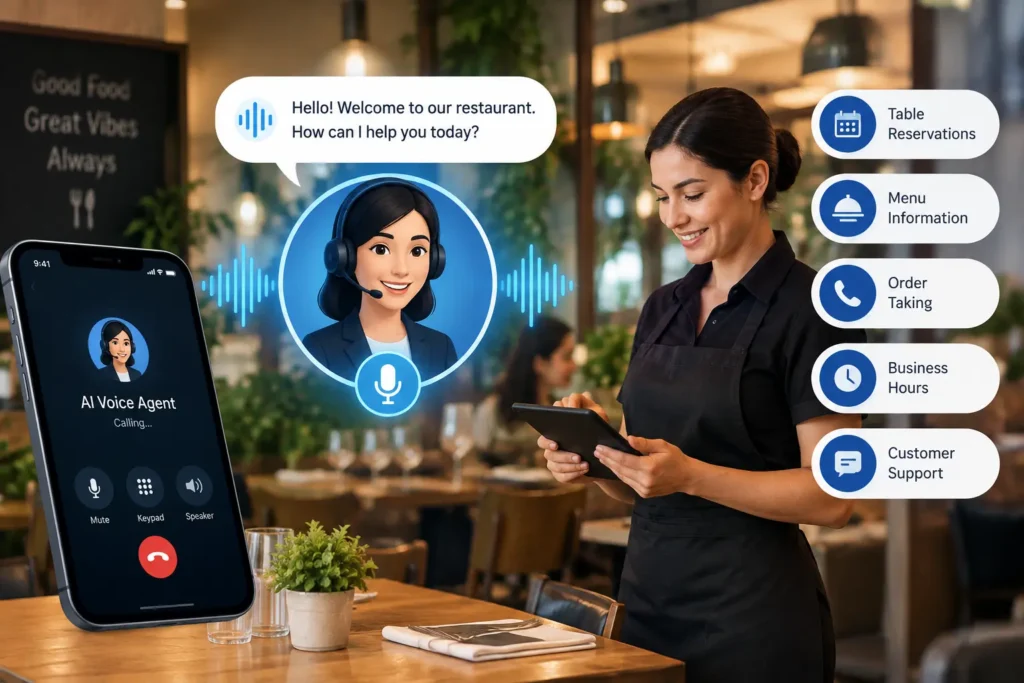
AI voice agents for restaurants are phone systems that use speech recognition and conversational AI to talk to callers, answer approved questions and, when connected to your POS or booking software, take orders and reservations. They work well on repetitive calls and poorly when menu data, integrations or caller languages are weak.
A restaurant phone rings at the worst possible time. The team is plating dinner, packing delivery bags or serving a full floor. When nobody can answer, the caller waits, rings again or orders somewhere else.
That is why more owners are looking at AI voice agents for restaurants. Is one right for every restaurant? Not necessarily.
It depends on your call mix, your menu, your POS and the languages your callers actually speak.
If your customers mostly message instead of call, an AI restaurant chatbot is the better first step.
This guide covers how restaurant voice AI works, which calls to automate, what to expect from Urdu and Punjabi callers in Pakistan, what it costs, and a test script to run before you sign anything.
What Are AI Voice Agents for Restaurants?
An AI voice agent is software that speaks with customers over the telephone, a service often called AI phone answering. Unlike a recorded phone menu, it interprets spoken requests and replies in natural language, based on its setup and the information it can access.
Depending on the system, it may:
- Answer questions about opening hours, location and payment options
- Share approved menu and price information
- Collect takeaway or delivery order details
- Help with reservation requests through a supported booking system
- Route calls to the right team member
- Take messages and callback requests after closing time
Not every product does all of this. Answering a menu question is easy. Submitting a confirmed order to your POS is a different job, and it is where products differ most.
Before you buy, sort every task into three groups: what the agent completes alone, what needs a software integration, and what must go to a person.
How Does Restaurant Voice AI Work, Step by Step?
A typical AI phone agent chains five parts together: the phone line, speech recognition, language understanding, your business data and a spoken reply.
- The customer calls. The call may go straight to the agent, be forwarded after a few rings, or switch over after closing time. Decide in advance which calls the AI takes.
- Speech recognition turns speech into text. Background noise, accents, phone quality and unfamiliar dish names all affect accuracy.
- The AI works out the intent. Opening hours need one approved answer. A takeaway order needs quantities, modifiers, pickup time and a contact number. It should ask a clarifying question instead of guessing.
- It checks your data or an integration. It may read the live menu, check bookings or send the order to your POS. Without a live menu link, it will not know an item sold out or a price changed. It should also never say an order is placed until the connected system confirms it.
- It replies or hands over. Text-to-speech turns the answer into voice. If it cannot resolve the request, it should transfer the call, take a callback request or explain the alternatives.
The goal is not to automate every conversation. It is to handle the right ones and give everyone else a clear path to a person.
Illustrative scenario: it is 8 p.m. on a Friday at a restaurant in Gulberg, Lahore. A caller says, “Ek half chicken karahi aur do naan chahiye, pickup 8:45 tak.” The agent must catch the dish, portion, quantity and time from one mixed Urdu and English sentence, then check availability and read the order back.
Speed matters too. In a PNAS study of ten languages, the average gap between one speaker finishing and the next starting was about 208 milliseconds, from 7 ms in Japanese to 469 ms in Danish.
People are used to quick turn-taking, so long pauses feel unnatural. Time the delay yourself on a real phone call, not a browser demo.
Which Restaurant Calls Can an AI Voice Agent Handle?
The usefulness of a voice agent depends on the workflows it supports and how accurate your information is. Use this table to split your own call log.
| Call type | AI voice agent | What it needs |
|---|---|---|
| Opening hours, address, parking | Yes | Accurate details, updated for holidays |
| Menu and price questions | Yes, with live data | A menu connected to your POS |
| Takeaway or delivery order | Only if integrated | A POS or order system that accepts orders |
| Table booking | Only if integrated | A booking system that confirms availability |
| Order status | Sometimes | A link to your order system |
| Allergy or ingredient questions | Hand to staff | Verified ingredient and cross-contact data |
| Complaints and refunds | Hand to staff | Judgement and authority to decide |
| Catering and large groups | Hand to staff | Custom quotes and negotiation |
For takeaway orders, the call should end up in the same queue as counter and online orders. That is the job of your cloud-based restaurant POS, so ask every vendor whether the agent can submit orders or only read the menu.
Allergy questions need special care. If the agent cannot verify ingredients and cross-contact information, it should pass the call to an authorised team member rather than guess.
Will an AI Voice Agent Understand Callers in Pakistan?
Most guides on this topic are written for US restaurants and say little about language. In Pakistan, callers mix Urdu, Punjabi and English in one sentence, spell dishes several ways and give addresses by landmark.
So test language first, not last. Support differs by platform and by language, and mixed speech is the hardest case. Place a few calls yourself:
- A full order in Urdu, another in Punjabi, and one mixing both with English dish names
- Dishes as customers really say them, such as nihari, haleem and chicken tikka
- A delivery address given by landmark, such as “opposite the park in Gulberg”
- A caller who changes their mind halfway: “make that two naan”
- A call from a moving car or a noisy street
If the agent stumbles on several of these, limit it to simple questions and let people take the orders. CherryBerry RMS Call Center Services use trained agents who take calls in English, Urdu and Punjabi, with phone orders synced to your POS and kitchen display.
AI Voice Agent vs IVR vs Human Call Center: Which Fits?
These options solve different problems. Start from the customer experience and the tasks each one can complete.
| IVR | AI voice agent | Human call center | |
|---|---|---|---|
| How callers interact | Press keys or pick menu options | Speak naturally | Speak to a person |
| Best for | Simple call routing | Repetitive calls such as hours, menu and standard orders | Complex requests, complaints and upselling |
| Takes orders | No | Only with POS integration | Yes |
| Allergies and complaints | No | Not safely | Yes, with training |
| Languages | Fixed recorded prompts | Varies by platform | Depends on the team |
| Main weakness | Rigid menus frustrate callers | Noise, accents and mixed languages | Cost grows with staffing hours |
Many restaurants can combine them: IVR to route calls, AI for the predictable ones and a trained team when judgement matters.
Where Does CherryBerry RMS Fit?
Restaurant communication involves more than answering the phone, so judge each option against the workflow you actually need. CherryBerry RMS currently offers two ways to cover it: the human-supported call center services above, and WhatsApp ordering for customers who prefer messaging.
With WhatsApp AI ordering, customers browse the menu and send their order in a chat instead of calling.
Important distinction: WhatsApp AI ordering and a telephone AI voice agent are different technologies. Do not assume a WhatsApp workflow answers your phone. Confirm the features and integrations you need before you decide.
What Do Real Voice-Ordering Rollouts Teach Us?
Voice ordering has been tested at very large scale, with mixed results. McDonald’s tested AI voice ordering with IBM at about 100 restaurants and announced in June 2024 that it would end that partnership.
Nation’s Restaurant News cited a 2022 BTIG report putting accuracy in the low 80 percent range, against McDonald’s goal of 95 percent or more.
Taco Bell has rolled out voice AI at more than 500 drive-thrus. In 2025 it said it was weighing where voice AI fits and where staff serve customers better, such as very busy locations, according to the Wall Street Journal.
Drive-thrus are noisier than phone lines, so these are not a verdict on phone ordering. They are a reminder to set an accuracy target before launch, measure it on real orders and keep a person ready to step in.
How to Choose an AI Voice Agent for Restaurants: 7 Tests
Use this checklist before you sign a contract.
- POS and ordering integration. Ask whether the system can read data, submit orders, update records or only do limited actions. Watch a live order land in your own POS, not a demo account.
- Real conversations. Do not rely on a scripted demo. Test substitutions, incomplete orders, sold-out items and callers who change their mind. Use the Pakistan test calls above.
- Human handoff. Check that a transfer carries the caller’s details and a short summary, and what happens when nobody answers.
- Data protection. Ask whether calls are recorded, where transcripts are stored, who can see them and how long they are kept. Tell callers they are speaking to an automated assistant, and confirm the recording-notice rules that apply to you.
- Reliability. Ask about uptime, support hours and what happens if the phone line or an integration fails. Keep a backup number for customers.
- Accuracy target. Agree a target for order accuracy before launch, and review a sample of recorded calls every week.
- Total cost. Price it on your real call volume, as the next section explains.
How Much Do AI Voice Agents for Restaurants Cost?
Pricing varies by provider, call volume and features, so ask for a quote built on your own numbers. Compare 12-month totals using the same line items:
- Platform subscription
- Per-minute or per-call usage
- Phone number and telephony charges
- Setup and POS integration
- Menu upkeep when items or prices change
- Support and usage limits
- Staff time still needed for transfers and callbacks
A per-minute rate alone rarely tells the full story, because telephony, setup and integration may be billed separately. Ask for the all-in monthly total.
How Do You Measure the ROI of Restaurant Voice AI?
Judge a voice agent on business results, not on how many calls it answers. Track a baseline before launch, then compare like for like periods.
- Missed-call rate: the share of incoming calls that go unanswered
- Resolution rate: the share of calls completed without follow-up
- Order accuracy: the share of orders submitted correctly
- Transfer rate: the share of calls passed to a person
- Customer satisfaction: feedback on the call experience
- Cost per resolved call: relevant costs divided by calls resolved
Suppose a restaurant receives 600 calls a month and misses 60. Its missed-call rate is 60 ÷ 600 × 100 = 10%.
That does not mean 60 lost orders. Some callers only wanted opening hours or a delivery area. Count how many were real order enquiries, how many would have converted, and the margin on those orders.
Illustrative arithmetic (not CherryBerry pricing or any provider’s rate): say 30 of the 60 missed calls were order enquiries, 60 percent would have converted, and the average order is PKR 1,800 with a 35 percent margin.
That is 30 × 0.6 × PKR 1,800 × 0.35 = PKR 11,340 a month. If the system costs more than that to run, missed calls alone do not justify it.
AI Voice Agents for Restaurants: FAQs
What is an AI voice agent for restaurants?
It is software that answers restaurant phone calls using speech recognition and conversational AI. Depending on its setup and integrations, it can answer questions, take messages, book tables and collect or submit orders.
Can AI voice agents take restaurant orders over the phone?
Yes, but fully only when connected to your POS or ordering system. Without that link, they can collect the details and pass them to staff, so ask for a live demo of an order reaching your own kitchen screen.
How accurate is AI phone ordering?
It varies with menu, noise, accents and integration, and vendor figures are rarely independent. In McDonald’s IBM drive-thru test, accuracy was reported in the low 80 percent range in 2022, against a 95 percent goal. Set your own target and check recorded calls weekly.
Does AI voice ordering work in Urdu and Punjabi?
It depends on the platform, and callers who mix Urdu, Punjabi and English are the hardest case. Test your own callers’ speech, dish names and landmark addresses before committing. A trained human team is safer where the agent struggles.
What is the difference between an AI voice agent and IVR?
IVR plays recorded prompts and asks callers to press keys or pick options. An AI voice agent understands spoken requests and replies conversationally, and can take actions when integrations exist.
Can an AI voice agent integrate with my restaurant POS?
Some can, but compatibility and depth vary. Confirm your exact POS version and whether the agent can submit orders or only read the menu, then watch a test order arrive in your own system.
How much do AI voice agents for restaurants cost?
Costs usually combine a subscription, usage charges, telephony, setup and integration work. Ask for a quote based on your monthly call volume, and compare 12-month totals rather than headline rates.
Do I have to tell callers it is an AI, and can I record calls?
It is good practice to tell callers they are speaking to an automated assistant and to give a recording notice at the start. Rules differ by location, so confirm the requirements that apply to you with a legal adviser.
What is the best AI voice agent for restaurants?
The best one passes your own tests: it understands your callers, submits orders to your POS, hands over smoothly and costs less per resolved call than your current process. Run the seven tests above on a shortlist, using your menu and real call recordings.
Are AI voice agents suitable for small restaurants?
They can be, if your calls are repetitive and the cost per resolved call stays below what a missed or manually handled call costs you. Otherwise, simple call routing or a human-supported service may fit better.
Final Thoughts
AI voice agents for restaurants can automate selected phone conversations, but the value depends on your workflow, accurate menu data and integrations. Identify your most common call types, test with realistic scenarios, confirm the human handoff and calculate the return from your own call data.
Want to see how phone orders, WhatsApp orders and your POS can work together? Book a free CherryBerry RMS demo or request a custom quote.