

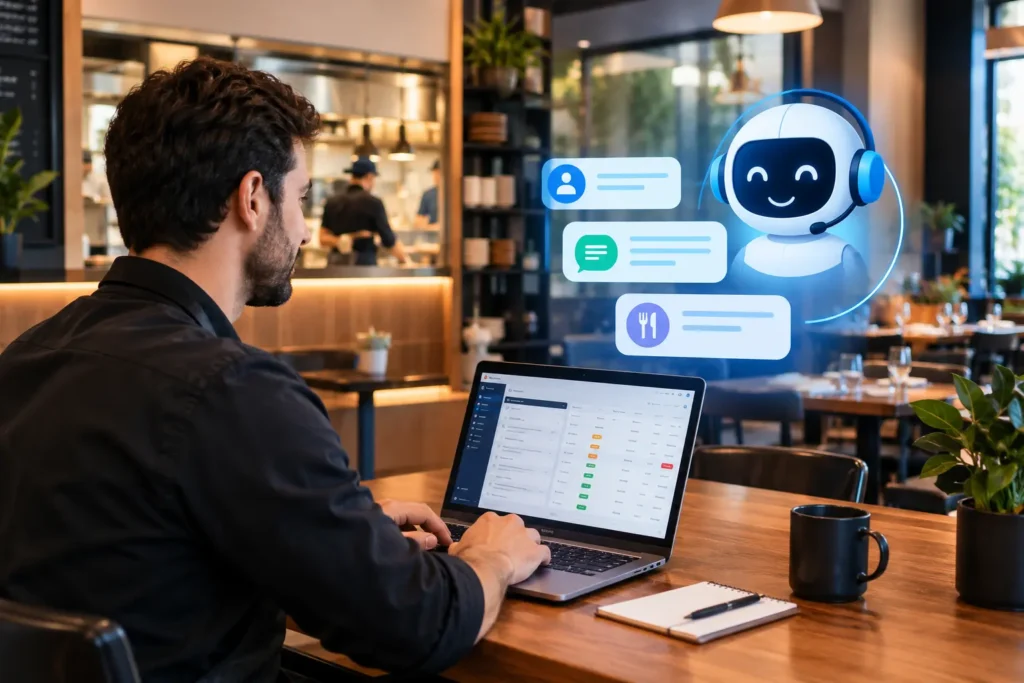
AI customer support for restaurants uses artificial intelligence to answer guest questions, take orders and bookings, and send order updates across WhatsApp, website chat, social media, and the phone. It works at any hour, handles many conversations at once, and passes sensitive issues to your staff with the full chat attached.
Support is a different job from selling. A guest who asks “Are you open?” or “Where is my order?” wants a fast, correct answer. A guest who is upset about a cold order wants a person.
AI customer service for restaurants tells the two apart. It answers routine questions in seconds. It hands everything else to your team. That keeps your staff on the floor and your guests from waiting.
This guide covers how it works across chat, WhatsApp, and phone. It also explains what should stay with your staff, how to keep answers accurate, and how the main tools compare. You will find advice for restaurants, cafés, fast-food outlets, desi kitchens, medical stores, and retail shops. For a closer look at the chat assistant itself, read our AI restaurant chatbot guide.
Key Takeaways
- AI handles routine questions, order status, and bookings. Staff handle complaints, refunds, and allergy questions.
- Missed calls and slow replies cost real orders, especially during peak hours.
- Accuracy depends on a knowledge base you control, not on the AI model alone.
- Integration with your POS matters more than any single chatbot feature.
- Start with one channel and your top twenty questions, then expand.
What Is AI Customer Support for Restaurants?
AI customer support for restaurants is a set of tools that use conversational AI to handle guest conversations. Staff would otherwise answer these by hand. It covers three jobs:
- Answering questions: hours, menu, prices, deals, and delivery areas
- Completing tasks: orders, reservations, and order status checks
- Triaging problems: complaints, refunds, and allergy questions go to the right person fast
In practice, it takes two main forms. The first is a chat assistant on WhatsApp, Instagram, and your website. The second is an AI voice agent that answers phone calls. Most restaurants start with chat, because that is where most messages already arrive.
What AI Customer Support Handles at a Glance
- Questions: opening hours, menu, prices, deals, delivery areas, parking, and item availability
- Order help: order status, address confirmation, and changes before dispatch
- Bookings: availability, changes, cancellations, and reminders
- Feedback: a short request after the order, with unhappy replies flagged to a manager
- Handover: complaints, refunds, allergy questions, and large orders go to a person
What It Should Not Do
The limits matter as much as the features. It should not promise a dish is allergen-free in a shared kitchen. It should not invent menu items or prices. It should not settle a refund dispute alone. The best setups treat these as escalation points, not failures.
Why Restaurants Need AI Customer Support Now
Guests expect fast answers, and they will not wait long. A 2025 Harris Poll commissioned by the AI vendor Hostie found that 63% of Americans prefer to call a restaurant. It also found that 69% would likely give up on a restaurant if nobody answered the phone, and 89% would be open to using an AI agent for restaurant tasks. This is U.S. data from a vendor-sponsored survey, so treat it as a directional signal.
The problem is real in busy kitchens. Revmo’s 2026 State of Calls Report analysed 12,091 restaurant calls. It found that quick-service restaurants missed about 40% of calls. Fast casual missed about 25%, and full-service restaurants missed about 9%. The report comes from a vendor too, but the pattern is clear: speed-focused outlets lose the most.
Pakistan’s digital habits point the same way. DataReportal counted about 117 million internet users in Pakistan in October 2025, which is 45.6% of the population. It also reported about 79.9 million social media user identities. Guests already message businesses on their phones.
A Realistic Example: A BBQ Restaurant in Lahore
Imagine a busy BBQ restaurant with two branches. Together they receive about 120 WhatsApp messages and 40 calls a day. This example is illustrative, so use your own numbers.
Most of those messages ask the same things: “Are you open?”, “Do you deliver to DHA?”, and “Where is my order?” If each reply takes a staff member 90 seconds, that is about three hours of typing a day.
Suppose an AI assistant handles 60% of those routine messages. That frees roughly 1.8 hours daily, or about 54 hours a month. The team spends that time on the counter, the kitchen pass, and guests who need a person.
How AI Customer Support Works in Four Steps
- It understands the message. The system reads what the guest wrote, in their language. It works out whether it is a question, an order, a booking, a complaint, or a status check.
- It answers from your approved knowledge base. That means the live menu, prices, branch timings, delivery zones, deal terms, and policies. If the answer is missing, it says it will check instead of guessing.
- It acts or hands over. For routine requests, it completes the task on the connected system. Complaints, refunds, allergy questions, and large orders go to a person.
- It records and improves. Every conversation saves to the customer record. A regular review of unanswered replies shows what to add next.
Integration matters more than the AI model itself. An assistant that does not connect to your POS can only talk. It cannot look anything up.
How It Stays Accurate
Owners rightly worry that an AI will invent a price or a deal. Support AI is only trustworthy when you limit what it can answer from. A well-built system uses a knowledge base you control. If the answer is not there, it passes the question to staff.
The AI is only as current as your data. When a price changes or an item sells out, update it in one place, ideally the POS. The chatbot, the app, and the counter then show the same thing.
Which Channels Does AI Customer Support Cover?
Text Channels: WhatsApp, Instagram, Messenger, and Website Chat
Text is where AI support is most mature. Customers can send a location pin, a screenshot, or a voice note. The conversation stays on record for both sides. For most restaurants, WhatsApp carries the bulk of the volume, so it is the sensible place to start. To let guests place the order itself in chat, see our WhatsApp AI ordering system for restaurants.
Your Restaurant’s WhatsApp Chatbot vs Meta AI
Customers sometimes mix up two different things. Meta AI is Meta’s own general assistant inside WhatsApp. It knows nothing about your menu, prices, or orders.
A restaurant’s WhatsApp AI chatbot runs on your own business number through the WhatsApp Business API. It answers from your data and can take real orders. When you promote your number, tell customers to message your restaurant directly.
Phone Calls: AI Voice Agents vs IVR vs Call Centers
An IVR is the familiar “press 1 for orders” menu. It routes calls but does not understand them. An AI voice agent answers the call, understands spoken requests, and can take simple orders. Our guide to AI voice agents for restaurants explains how it compares with IVR and human agents.
Voice AI is improving quickly. Accents, background noise, and mixed Urdu and English remain harder for voice than for text. Test it with real calls before you rely on it.
Many restaurants handle phone customers better with trained people. A restaurant call center gives callers a real agent while AI handles messaging channels. Both can feed the same POS and customer record.
One Customer Record Across Channels
Omnichannel support only works if channels share data. A customer who ordered on WhatsApp yesterday and calls today should not repeat their address. Ask any provider how chat, phone, and app orders end up in one profile.
AI Customer Support vs Human Staff: Who Should Handle What
AI is not about removing people from the job. It stops them from answering the same question for the hundredth time. Use this table as a starting point for your own rules.
| Situation | Best handler | Why |
|---|---|---|
| Opening hours, location, delivery areas | AI | Fixed answers, high volume |
| Menu, prices, deals, availability | AI | Fast, consistent, always current if data is updated |
| Standard orders and order status | AI | Routine tasks connected to the POS |
| Reservations and reminders | AI | Clear rules, easy to confirm |
| Complaints about food or lateness | Staff | Needs empathy and judgement |
| Refunds and billing disputes | Staff | Money decisions stay human |
| Allergy and dietary safety | Staff | Safety risk if wrong |
| Catering, corporate, and event orders | Staff | Complex and high value |
When the AI Should Hand Over to a Human
Set clear triggers. The AI should pass the conversation to staff when a customer:
- Asks for a person
- Uses angry or upset language
- Mentions an allergy or a refund
- Places an unusually large order
- Asks the same thing twice without getting an answer
The handover should include the full chat history. Name one person responsible for picking it up within an agreed time, even late at night.
Who Benefits Most From AI Customer Support?
Every food business answers repeat questions. The pain points differ by type.
- Full-service restaurants: Booking changes and special requests fill the inbox. AI handles availability and reminders. Staff handle celebrations and dietary needs.
- Cafés and bakeries: Guests ask about stock, opening times, and custom cakes. AI answers instantly and passes custom orders to staff.
- Fast food and QSR: Calls spike at lunch and dinner. Messaging automation catches orders that phones miss.
- Desi restaurants and BBQ spots: Guests write in Urdu, Roman Urdu, and English. Look for a system that handles all three. Eid, Chaand Raat, and 14 August bring huge surges.
- Cloud kitchens and multi-branch chains: One dashboard keeps menus and answers consistent across branches.
- Medical stores and retail shops: Customers ask “Is this in stock?”, “Do you deliver?”, and “What time do you close?” AI answers these fast. Medical stores must never let AI give clinical advice. Route those questions to a qualified person.
How Popular Tools Compare
AI support tools cover different parts of the job. They are not all direct competitors. Verify language support, pricing, and POS integration for your market before you decide.
| Tool | Main focus | Best for | Check before buying |
|---|---|---|---|
| Slang AI | Phone answering and reservations | Restaurants wanting a virtual receptionist | Market availability and local language support |
| SoundHound AI | Voice ordering and phone automation | High call-volume outlets | POS integration and accent handling |
| ConverseNow | Automated phone orders connected to POS | QSR and chains | Fit for small independents |
| Tidio Lyro | Website chat and automated FAQs | General online support | Restaurant-specific order and menu data |
| CherryBerry RMS | WhatsApp AI, POS, and call center in one system | Pakistan-based restaurants and chains | Confirm features during a demo |
Many tools focus on phone calls or generic website chat. Fewer connect WhatsApp, POS, kitchen, and customer records in one place. That connection decides whether answers stay accurate.
Build It Yourself or Use a Restaurant-Ready System?
General chatbot builders can answer a short, stable list of questions. A restaurant needs more. The assistant must read live menu and order data.
- A general chat builder: works for fixed FAQs. Your team maintains the menu data, the WhatsApp API access, and the handover rules.
- A system built into your restaurant software: order status, menu, and customer records come from the same place as your POS.
Ask for the full cost breakdown before signing. Include the subscription, Meta’s per-message charges on the WhatsApp Business API, and setup fees.
What Does AI Customer Support Cost?
No honest guide can give one price. These factors drive the cost:
- Number of branches and channels
- Message and call volume
- WhatsApp Business API charges from Meta
- Setup, integration, and staff training
- Plan tier and add-ons such as voice or reporting
Compare what the base plan includes against what costs extra. Then weigh the price against the staff hours and missed orders you recover.
How to Roll Out AI Customer Support in 30 Days
You do not need to automate everything on day one.
- Week 1: List your top twenty questions. Write approved answers and escalation rules.
- Week 2: Connect your menu, prices, and branch timings. Set up WhatsApp.
- Week 3: Launch quietly. Review every conversation daily and fix wrong answers.
- Week 4: Add bookings or order status. Promote your number to regular customers.
The full six-step rollout plan lives in our chatbot guide.
Test It Yourself: Five Messages to Send Before You Commit
A demo always handles the easy questions. These five messages show how a system behaves under pressure. Send them from a real phone.
- “Is this dish nut-free?” A safe reply promises nothing it cannot verify. It passes the guest to staff.
- “Mera order abhi tak nahi aaya.” The reply should check status and answer in the same language.
- “I want a refund.” The system should apologise, collect details, and route the case to a manager.
- “Can I speak to someone?” It should hand over at once.
- The same unanswerable question, twice. It should stop looping and offer a person or a callback.
If any reply invents an answer or ignores a request for a person, fix the rules before launch.
How to Measure Whether It Is Working
Pick a handful of numbers before launch and check them monthly:
- Average first response time, before and after
- Resolution rate without a human
- Orders and bookings placed through chat
- Missed or unanswered messages after hours
- Order errors and cancellations at the door
- Repeat orders from customers in your database
- Satisfaction scores and handover pickup time
If response time improves but chatbot orders stay flat, the problem is usually promotion, not the chatbot.
Customer Data, Privacy, and Trust
AI support collects names, numbers, addresses, and order history. Treat that data with care. Meta’s documentation explains how messages travel through the WhatsApp Business Cloud API and how long it keeps message content. Read it before you sign with any provider.
Ask where customer records live afterwards, who on your team can see them, and how a customer can request removal. Only send marketing messages to customers who agreed to receive them.
How CherryBerry RMS Approaches AI Customer Support
CherryBerry RMS builds its AI customer service into the WhatsApp AI ordering system, not as a standalone tool. The chatbot greets customers, shares the menu, and answers questions in English, Urdu, and Roman Urdu. It takes orders with cash on delivery and sends real-time status updates.
Confirmed orders go straight into the CherryBerry cloud POS and kitchen display. Inventory and accounting update automatically. The same customer record is shared with the call center team, so a phone caller and a WhatsApp customer are the same person.
It runs on Meta’s official WhatsApp Business Cloud API and supports multi-branch operations from one dashboard. The local onboarding team handles API verification, POS integration, and staff training. Chatbot orders flow through the same FBR POS invoicing system as every other sale. Callers who prefer the phone reach trained agents through the 24/7 call center.
Want to see it handle a real order in Roman Urdu? Book a demo and send it one.
Conclusion: Answer Faster Without Losing the Human Touch
Good AI customer support does not replace your team. It takes the repeat questions off their plate. It answers in seconds, at any hour, and hands the hard conversations to a person.
Start small. Pick one channel, write your top twenty answers, set clear handover rules, and review the conversations daily. Measure response time and missed messages. The results will show you where to expand next.
Frequently Asked Questions
What is AI customer support for restaurants?
It uses conversational AI to answer guest questions, take orders and bookings, send order updates, and route complaints to staff. It works across WhatsApp, website chat, social media, and phone. It hands sensitive conversations to a person.
Can AI answer restaurant phone calls?
Yes. AI voice agents can answer calls, respond to common questions, and take simple orders or bookings. Accents, noise, and mixed Urdu and English are still harder for voice AI. Many restaurants use AI for messaging and trained agents for calls.
When should AI hand a conversation to a human?
Hand over when the customer asks for a person, sounds upset, mentions an allergy or refund, places a large order, or repeats an unanswered question. The handover should include the full chat history.
Does AI customer support replace restaurant staff?
No. It handles repetitive, high-volume conversations. Staff keep complaints, special requests, and large catering orders. The best setups combine AI with human handoff.
What happens when the chatbot cannot answer?
It should pass the chat to staff or collect details for a callback. It should never invent answers about prices, ingredients, or policies.
What is the difference between AI customer support and an AI restaurant chatbot?
A chatbot is the software that talks to guests. AI customer support is the job it does: answering, helping with orders and bookings, and escalating problems.
Can AI handle restaurant complaints?
It can collect details, apologise, and route the complaint to a manager quickly. It should not decide refunds or compensation. Those stay with staff.
Should a restaurant tell guests they are talking to an AI?
Many restaurants add a short opening line, such as “You are chatting with our virtual assistant. Type ‘person’ to reach our team.” It sets expectations. Check the disclosure rules in your market.
How do I stop an AI from giving wrong information?
Limit it to a knowledge base you control. Update prices and availability in one place. Review a sample of conversations every week.
Does AI customer support work after closing time?
Yes for routine questions, bookings, and order messages. Sensitive cases still need a person. Agree who picks up handovers the next morning.
Can small restaurants and cafés afford AI customer support?
Often, yes. Start with one channel and basic answers. Compare plan tiers, WhatsApp message charges, and setup fees. Then weigh the cost against staff hours and missed orders.
Can medical stores and retail shops use AI customer support?
Yes, for stock, delivery, and opening-hours questions. Keep clinical or medical advice with a qualified person.
Sources and Further Reading
For Pakistan’s digital landscape, see DataReportal’s Digital 2026: Pakistan report. For how WhatsApp handles business messages and data, read Meta’s WhatsApp data privacy and security documentation.
that the system connects to your stock data.