

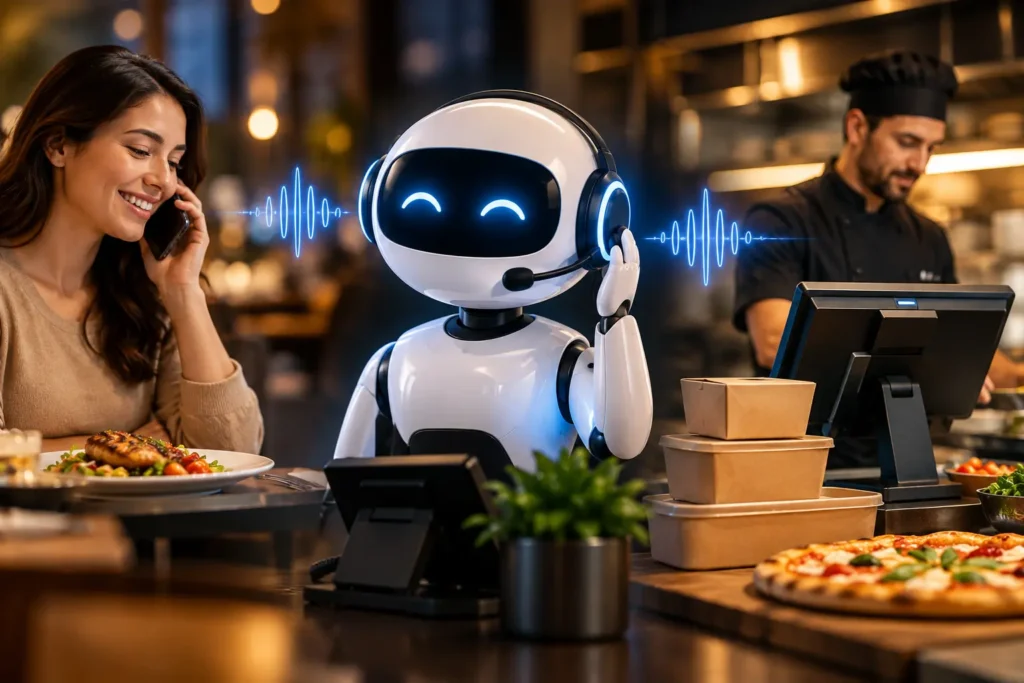
It is 7:40 on a Friday evening. The host is seating a family of six, the kitchen is two tickets behind, and the phone has been ringing for a full minute. By the time someone reaches it, the caller has hung up and rung the restaurant down the road. That call might have been a delivery order, a booking for Saturday, or a regular asking for their usual. You will never find out which.
AI phone answering for restaurants is software that picks up those calls instead. It answers in a natural voice, works out what the caller wants, handles routine requests such as menu questions, bookings and simple orders, and passes anything delicate to a person. This guide explains how it works, what it can and cannot handle, why POS integration decides whether it is useful, and how to test a system before you commit to one.
an AI phone answering system works best as a first responder, not a replacement for your team. It answers every call, resolves the routine ones, and hands the rest to staff with context. It earns its cost only if it writes orders and bookings straight into your POS and kitchen display, copes with your callers’ languages and accents, and follows clear rules about when to transfer a call.
What Is AI Phone Answering for Restaurants?
AI phone answering for restaurants is a voice-based system that answers incoming calls automatically, understands spoken requests, and replies in a synthetic voice. It can answer questions, take bookings and simple orders, and transfer calls to staff. It is also sold as AI call answering, an AI voice agent, or a restaurant AI receptionist.
The terms overlap, so it helps to separate them. Conversational AI is the broad field. A voice AI agent is conversational AI working on a phone line. An Interactive Voice Response (IVR) system is the older “press 1 for orders” menu: it routes calls but does not understand them. Many restaurants still run an IVR, and it is a different thing from an AI that can hold a conversation.
Why Restaurants Miss Calls, and What Each One Costs
Phone traffic peaks at the same moment service peaks: lunch, dinner, Friday night, a holiday weekend. That is when the host is seating guests, the cashier is serving a queue and the manager is expediting. A phone line also handles one conversation at a time, so a second caller hears a busy tone or rings out. Outside opening hours the call goes to voicemail, if there is one, and a caller who wanted an answer now rarely waits for a callback.
You can put a number on this before spending anything. Use this formula with your own figures:
Good missed call management starts with a count. Get the missed-call number from your phone provider’s call log, or ask the host to tally unanswered calls for two weeks. The result is the ceiling on what any phone automation can recover. If it is small, a better phone routine may be enough. If it is large, the rest of this guide is worth your time.
How to Reduce Missed Calls in a Restaurant
AI is one option, and not always the first one. These cheaper fixes are worth making whatever you decide:
- Remove the questions callers should never need to ask. Keep opening hours, address and delivery areas accurate on your Google Business Profile and website, so fewer people phone for basics.
- Send repeat traffic to a link. A text message with your online ordering or booking link answers many calls without a conversation.
- Give the phone an owner at peak times. A named person or station beats a handset on the wall that anyone might answer.
- Ring more than one device. Forward the line to a manager’s phone or a ring group so a call always has somewhere to go.
- Return missed calls. Log unanswered numbers and call back within the hour.
- Add outside help for overflow. A restaurant call center or AI answering covers peak-hour call handling and the after-hours calls.
How Does AI Phone Answering Work?
A call that sounds like a simple chat runs through six steps. Knowing them lets you ask vendors better questions.
- The call reaches the system. Your restaurant number is forwarded, or moved, to a cloud telephony layer from a provider such as Twilio or a contact-centre platform. The system captures the caller’s number, so a returning customer can be recognised.
- Speech becomes text. Automatic Speech Recognition (ASR) transcribes what the caller says in real time, while they are still talking.
- The system works out what they want. Natural language processing (NLP) classifies the intent (question, order, booking, order status, complaint, request for a person) and pulls out the details: items, quantities, party size, time and address.
- It checks real restaurant data. The dialogue logic looks at your menu, opening hours, table availability and live order status. This step stops the system from guessing, and it only works if it is connected to your Point of Sale (POS) and booking calendar.
- It answers out loud. Text-to-Speech (TTS) turns the reply into a voice. Better systems let callers interrupt mid-sentence, the way people do on a real call.
- It acts, or hands over. The order goes into the POS and the Kitchen Display System (KDS), a confirmation is texted, or the call is transferred to a staff member with a short summary of what has been said.
AWS publishes a worked example of this pattern. Its restaurant telephony AI host build separates the phone layer, the real-time speech layer and the ordering logic, and gives the AI agent named tools such as placing an order, so the restaurant backend can change without rewriting the agent. It also shows two details worth remembering. The system identifies a caller by phone number, which AWS notes is not identity verification, so anything sensitive needs a further check. And it uses end-of-turn detection to shorten the gaps between the caller and the agent, because long pauses are what make an automated call feel broken.
What Can an AI Phone Agent Handle in a Restaurant?
Routine, repeatable calls are where AI voice agents earn their place:
- Common questions. Opening hours, address, parking, delivery areas, menu items, and dietary information that you have supplied.
- Takeaway and delivery orders. This is automated phone ordering: the system takes the items, reads the order back, confirms details and sends it to the POS and KDS.
- Reservations. Collecting party size, date and time, checking availability and confirming by text.
- Order status. Answering “where is my order?” from live order data instead of tying up a staff member.
- After-hours calls. Capturing late bookings and next-day catering enquiries that would otherwise reach voicemail.
- Call routing and escalation. Transferring to the right person, with a summary, when the request needs one.
- Sending links. Texting a menu, ordering or booking link. Toast’s own documentation describes an AI phone integration that answers calls, pushes the order to the POS and kitchen screens, and can text callers a link to finish ordering online.
Where it struggles is just as important. Speech recognition gets harder with a noisy room, a caller on speakerphone, strong regional accents, and callers who switch language mid-sentence. Complicated custom orders, with several substitutions and a change of mind, are harder still. None of this rules AI out. It means you test with calls that sound like your real callers, not the vendor’s demo line.
What Should Stay With Your Staff
Set the boundary before you switch anything on. These calls should reach a person quickly:
- Allergy and dietary safety questions
- Complaints about food quality or a late order
- Refunds, compensation and billing disputes
- Large catering, corporate and event orders
- Regular or VIP guests who ask for a person
- Any caller who repeats the same question twice without an answer
A good handover is a warm transfer. The staff member sees what the caller has already said, so the guest does not start again. Agree who picks up transferred calls at each hour of the day, including late evening, before launch.
AI Voice Agent, IVR, Call Center or Voicemail: Which Phone Setup Fits?
These options are often presented as rivals. For most restaurants they are layers, and each one does a different job.
- Voicemail. Free and always available, but it turns an order into a callback task. It suits a restaurant with very few calls.
- IVR menu. Routes callers to the right department or branch. It does not understand speech, so it is a poor way to take an order.
- Human call center. Trained agents handle nuance, accents, complaints and upselling judgement, and they can follow your greeting and tone. Cost scales with staffing, and it suits high call volumes and complicated orders. CherryBerry RMS’s restaurant call center services work this way, with calls routed by IVR and orders syncing to the POS.
- AI voice agent. Handles many calls at once, around the clock, with consistent answers. It is strongest on routine calls and weakest on noise, mixed languages and complicated requests.
- Hybrid. AI answers first and transfers when it should, or a call center covers calls the AI cannot resolve. This is where many busy restaurants end up.
- Messaging channels. Guests who would rather type than talk use WhatsApp or chat. That is a separate channel, covered in our guides to AI customer support for restaurants and WhatsApp AI ordering.
Phone, messaging and app orders should end up in one place. Run each channel as its own queue and your staff become the integration layer, copying orders between screens.
Why POS Integration Decides Whether It Works
An AI phone ordering system that takes an order but cannot put it in your POS is an answering machine with extra steps. Someone still has to retype the ticket, and retyping is where mistakes and delays come from. When you assess integration, ask for specifics:
- Does it read your live menu, including items marked unavailable?
- Does it write the order into the POS and the KDS without staff touching it?
- Does it capture the customer’s number and address against a record in your CRM or POS?
- What happens to the order if the POS is offline or the call drops halfway?
Check how the connection is offered, too. In Toast’s case, its support documentation says a restaurant needs access to Toast Partner Integrations before it can enable this kind of AI phone integration. Availability depends on your POS vendor’s program, so confirm that your system is supported before you fall for a demo.
Languages, Accents and Noisy Rooms
Most voice AI is built and tested in English first. If your callers mix languages, that matters. In Pakistan, for example, a single call can move between English, Urdu and Punjabi, and a system built around English alone will miss much of it.
When you assess a system, ask which languages it understands natively and which it translates, because translation adds delay and errors. Then test it with the accents on your actual call list, and test with kitchen noise in the background. Multilingual voice assistants are only useful if they work for the people who ring you.
How to Choose an AI Phone Answering System: Ten Questions
- Does it write orders and bookings into my POS and KDS? Ask which systems it supports and how the connection works.
- What happens when it does not understand? You want a transfer to a person, or a voicemail with a transcript, never a loop.
- Which languages and accents does it handle natively? Test them yourself.
- How fast does it respond? Pauses of a second or two on a phone call feel like a fault.
- Who updates the menu and opening hours, and how fast? Prices change and items run out. Updates should take minutes, without a support ticket.
- Can I hear real recordings and read transcripts? You need a way to review how calls actually went.
- How are payments handled? A common approach is a text message with a secure payment or ordering link rather than card numbers read aloud. Ask about PCI DSS compliance and how card data is kept out of recordings.
- What does it cost in full? Providers price by minute, by call, by order or by flat subscription, and phone costs, setup and extra locations can sit on top. Ask for an estimate based on your own call log. See the pricing note in the FAQ below.
- What are the recording and disclosure rules? Rules on recording calls and telling callers they are speaking to AI vary by country and region. Confirm what applies to you.
- Who supports you after launch? The first weeks need tuning. Ask who sits with your manager to fix awkward answers, and whether you can keep your existing number.
Run Eight Test Calls Before You Commit
A demo shows the system at its best. These eight calls show it at its worst, which is what your guests will hear on a bad night:
- A simple question: “What time do you close tonight?”
- A messy order with a substitution and a change of mind: “Actually, make that two.”
- An order in the language or mix of languages your callers use
- A booking for an awkward party size at a peak hour
- A call from a phone speaker with background noise
- A mention of a nut allergy. The system should hand over to a person.
- A request to speak to someone. The transfer should be quick and clear.
- A call that drops halfway, followed by a call back. Does it remember or start again?
After each call, check what arrived in the POS. A call that sounded fine but produced a wrong ticket is a failed call.
Rolling It Out Without Annoying Your Regulars
You do not need to give AI every call on day one. A safer sequence:
- Pull your call log. Know your peak hours, missed-call volume and the most common reasons people ring.
- Clean your source data. Menu with prices and variations, opening hours including holidays, delivery zones and charges, booking rules.
- Write the handover rules. Decide which calls always transfer, who answers them, and at what hours.
- Start with overflow and after-hours calls. Let AI take calls your team cannot reach anyway, then widen as the results justify it.
- Review transcripts daily for two weeks. Fix wrong answers, tighten the rules, then reduce the checking.
How to Measure Whether It Is Working
Record a baseline before launch, then compare monthly:
- Share of calls answered, and missed calls at peak hours
- Calls resolved without staff involvement
- Orders and bookings captured by phone
- Order accuracy, measured by remakes, refunds and complaints
- Transfer rate and the reasons behind it
- Callers who hang up before finishing
- Time staff spend on the phone during service
If answered calls rise but phone orders stay flat, look at how people are finding and using your number before blaming the technology.
Where CherryBerry RMS Fits
CherryBerry RMS covers the phone in a connected way. Its restaurant call center services give callers a trained agent, with 24/7 availability, intelligent call routing (IVR), reservation handling, call logging against the customer record, and phone orders that reach the POS and kitchen display in the same way as counter orders. For guests who prefer to message, WhatsApp AI ordering uses AI to answer questions and take orders on WhatsApp, in English, Urdu and Roman Urdu.
All of those orders land in one cloud-based POS system and one kitchen queue, alongside the online ordering app, table reservations and rider app deliveries. If you are weighing any AI voice product, CherryBerry’s or anyone else’s, the checklist and test calls above are the way to compare them.
To see how a phone order, a WhatsApp order and a counter order reach the same kitchen screen, book a demo and ask for the call center walkthrough.
Frequently Asked Questions
What is AI phone answering for restaurants?
AI phone answering for restaurants is a voice-based system that answers incoming calls automatically, understands what the caller wants, and replies in a synthetic voice. It handles routine requests such as opening hours, bookings and simple orders, and transfers anything sensitive to a staff member.
How does AI phone answering work for restaurants?
The call is routed to a cloud telephony layer. Speech recognition turns the caller’s words into text, natural language processing identifies the request, the system checks menu and booking data, a synthetic voice replies, and the order or booking is written into the POS. Complex calls are transferred to staff.
Can AI take restaurant phone orders?
Yes, for straightforward orders. The system confirms items, reads the order back and sends it to the POS and kitchen display if it is integrated. It struggles with noise, strong accents and heavily customised orders, so test it with realistic calls and keep a path to a person.
Is AI phone answering suitable for small restaurants?
It can be, if missed calls are a real problem. Count your missed calls over two weeks first. A small restaurant with few calls may be better served by a simple call-forwarding routine, while one that loses calls at peak hours can start with AI on overflow and after-hours calls.
What is the best AI phone answering service for restaurants?
There is no single best option. The right system depends on your POS, the languages your callers speak, your call volume and your budget. Compare providers on POS write-back, handover rules, language support and full cost, and run test calls before choosing.
Can an AI voice agent handle restaurant reservations?
Yes. It collects the date, time and party size, checks availability against your booking system, confirms by text and handles changes. It needs a live connection to your reservation calendar, otherwise it risks double-booking tables.
Does AI phone answering work with my POS?
That depends on the AI provider and your POS vendor. Some POS systems offer partner integrations that let an AI agent read the menu and send orders to the POS and kitchen screens. Ask the provider to show a real order arriving in your POS.
How much does AI phone answering cost?
Pricing models vary: per minute, per call, per order or a flat monthly fee, with telephony, setup and extra-location charges sometimes added. Ask for a quote based on your own call log, and ask which charges are fixed and which grow with volume.
Can AI phone answering work 24/7?
Yes, software has no shifts, so it can answer at any hour. Someone still needs to own the handovers. Decide who follows up on after-hours bookings, complaints and transferred calls, and when.
How can restaurants reduce missed calls?
Keep hours and delivery areas accurate online, send repeat callers to an ordering or booking link, give the phone an owner at peak times, forward the line to more than one device, return missed calls quickly, and add outside help such as a call center or AI for overflow.
What happens when the AI cannot help the caller?
A well-configured system transfers the call to a staff member with a summary, or takes a message and sends a transcript. A system that loops the caller or ends the call is a poor fit, so test this before you commit.
October 2026