

Restaurant call center operations are the people, processes and software a restaurant uses to answer calls, take phone orders, confirm reservations and handle complaints, then send each order to the kitchen through its point-of-sale (POS) system.
A connected setup combines interactive voice response (IVR) routing, POS and kitchen display system (KDS) order entry, and missed-call reports. This guide covers how it works in Lahore and across Pakistan, and how CherryBerry RMS supports it through its restaurant call center services.
Restaurant call center operations cover customer calls, phone orders, reservations and delivery inquiries. During lunch, dinner or weekend rushes, handling every call manually gets difficult.
Staff may miss calls, enter wrong orders or keep customers waiting.
A well-organized call center gives restaurants a clear process for answering calls, recording orders and coordinating teams. When connected with a restaurant point-of-sale (POS) system and kitchen workflow, it also reduces manual order entry.
For restaurants in Lahore and across Pakistan, these processes need to account for peak dining hours, customer language preferences, delivery locations, cash-on-delivery orders and multi-branch operations.
This guide explains how restaurant call center operations work, how to optimize daily call handling, which performance indicators to track and how integrated restaurant technology can support the process.
What Are Restaurant Call Center Operations?
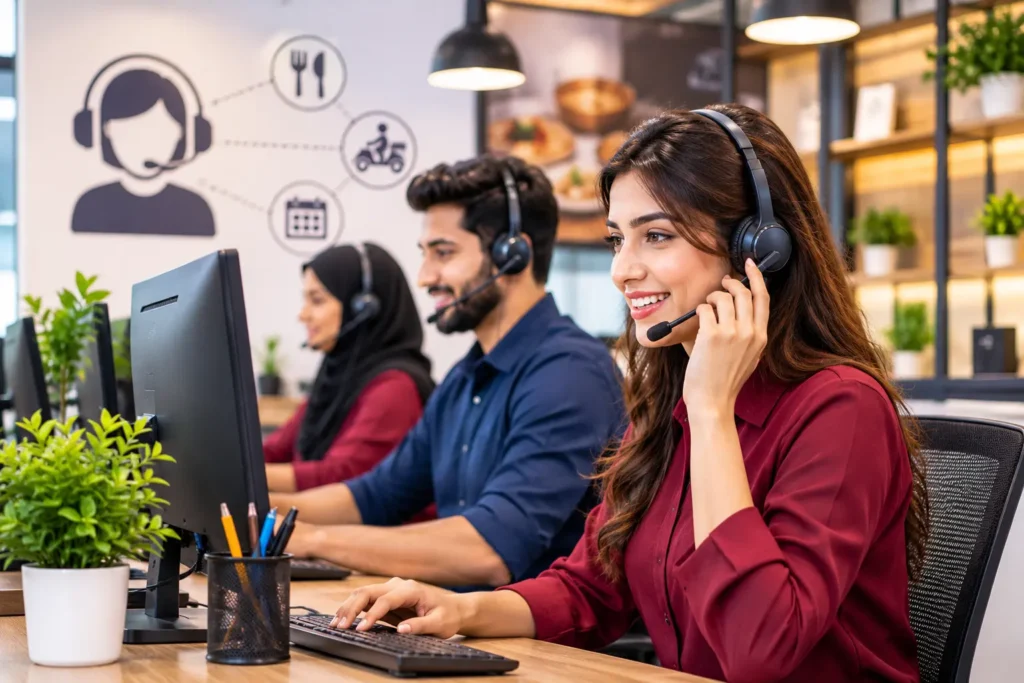
Restaurant call center operations are the people, processes and tools used to manage customer calls. They include answering inquiries, taking food orders, confirming reservations, handling complaints and giving order updates.
A restaurant call center may operate through an in-house team, an outsourced service provider or an integrated restaurant management system.
Its main objective is to make customer communication more organized while ensuring that orders and requests reach the correct restaurant team.
For example, a customer calls to order takeaway. The agent confirms the items and pickup or delivery details, then records the order in the restaurant’s system.
The kitchen receives it through the connected workflow, not handwritten notes.
How Do Restaurant Call Center Operations Work?
An effective restaurant call center follows a consistent process from the first customer interaction to order completion.
1. Receiving and Routing Customer Calls
The process begins when a customer contacts the restaurant. Depending on the call volume and setup, calls may be answered by an available agent or directed through an Interactive Voice Response (IVR) system.
IVR allows callers to select options such as new orders, existing orders, reservations or customer support. This helps direct inquiries to the appropriate team.
2. Identifying Returning Customers
Agents collect or confirm the caller’s phone number and relevant customer details. Where customer records are available, previous orders, saved addresses and preferences can help make repeat interactions more convenient.
Accurate customer information also helps agents avoid repeatedly asking regular customers for the same details.
3. Taking and Confirming Phone Orders
The agent records the customer’s requested items, quantities, sizes, add-ons, special instructions and order type.
Before submitting the order, the agent should repeat the important details to the customer. This confirmation step helps identify mistakes involving menu selections, delivery addresses, prices and payment methods.
4. Sending Orders to the Restaurant POS
Once confirmed, the phone order should be entered into the restaurant’s POS system.
An integrated workflow allows the kitchen team to receive the order through its normal order-processing system. This reduces the need for staff to re-enter information from paper notes or verbal instructions.
5. Coordinating Preparation and Delivery
After the order reaches the restaurant, kitchen staff prepare it according to the submitted details. The delivery team or rider handles the next stage for delivery orders, while pickup orders are prepared for customer collection.
The customer support team should have an appropriate way to respond to order-status inquiries.
6. Handling Complaints and Follow-Ups
Not every call results in a new order. Customers may ask about delayed deliveries, incorrect items, reservations or previous complaints.
Agents should record the issue, route it to the responsible team and follow the restaurant’s resolution procedure.
7. Reviewing Call Activity
Managers should review call volume, missed calls, customer complaints, order accuracy and agent performance regularly.
This information helps identify recurring problems and determine where staffing, training or workflow changes are needed.
7 Common Problems in Restaurant Call Center Operations
Restaurant phone support can become difficult when customer communication is not connected to daily operations.
1. Missed Calls During Peak Hours
Lunch and dinner rushes often create additional pressure on restaurant employees. When staff members are busy serving tables, processing payments or preparing orders, incoming calls may go unanswered.
A dedicated call-handling process, appropriate staffing and missed-call follow-ups can help reduce these opportunities being lost.
2. Incorrect Phone Orders
Manual note-taking and rushed conversations can result in incorrect quantities, missing items, wrong addresses or misunderstood special instructions.
Using a standardized order checklist and confirming details before submission helps improve order accuracy.
3. Disconnected Communication Between Teams
When call agents, kitchen employees and delivery staff work with separate information, orders may be delayed or misunderstood.
Connecting phone orders to the restaurant POS and kitchen workflow gives relevant teams a more consistent view of the order.
4. Inconsistent Customer Information
Different employees may provide different menu prices, promotional details, operating hours or delivery information.
A centralized and regularly updated menu and information source helps agents provide consistent answers.
5. Delayed Complaint Resolution
Customers become frustrated when they need to explain the same problem to multiple employees.
Agents should document complaints, identify the responsible department and establish a clear follow-up process.
6. Limited Visibility Into Call Performance
Without call records and performance reports, managers may not know when customers are waiting, which calls are missed or why repeated complaints occur.
Regular reporting makes it easier to identify operational weaknesses.
7. Difficulty Managing Multiple Branches
Restaurant chains may have different menus, delivery areas, operating hours and order volumes across their locations.
A centralized process with clear branch-specific information helps agents direct orders and inquiries correctly.
How to Optimize Restaurant Call Center Operations: 9 Practical Strategies
Improving restaurant call center operations requires more than hiring additional agents. Restaurants need clear processes, reliable information, suitable technology and regular performance reviews.
1. Create a Standardized Call Script
Prepare a simple call script covering:
- Restaurant greeting and customer identification.
- Order type: delivery, takeaway or dine-in inquiry.
- Menu selections and quantities.
- Add-ons and special instructions.
- Delivery address and nearby landmark.
- Payment method.
- Estimated preparation or delivery information.
- Final order confirmation.
Agents should use the script as a guide rather than reading every interaction mechanically.
2. Maintain an Updated Menu and Information Sheet
Every agent should have access to accurate restaurant information, including:
- Current menu items and prices.
- Available sizes and add-ons.
- Promotional offers and applicable conditions.
- Delivery charges and service areas.
- Branch operating hours.
- Temporarily unavailable items.
- Reservation policies.
The restaurant should assign responsibility for updating this information whenever prices, menus or operating conditions change.
3. Schedule Agents Around Actual Call Volume
Do not schedule employees based only on assumptions about busy hours.
Review call records to understand when incoming calls increase. Use that information to arrange staff coverage around lunch, dinner, weekends, holidays and seasonal demand.
For restaurants in Pakistan, Ramadan, Eid and other special occasions may create different customer calling patterns.
4. Use IVR and Intelligent Call Routing
A short IVR menu can help separate new orders, order-status inquiries, reservations and complaints.
For example:
- Press 1 for new food orders.
- Press 2 for existing order inquiries.
- Press 3 for reservations.
- Press 4 for customer support.
Keep the menu simple and make sure customers can reach an appropriate employee when necessary.
5. Connect Phone Orders With the POS System
One of the most important improvements is reducing repeated manual data entry.
When agents enter confirmed phone orders directly into an integrated POS system, the information can move into the restaurant’s normal order-processing workflow.
Where supported, integration with a Kitchen Display System (KDS) helps kitchen employees receive order details in an organized format.
6. Establish a Missed-Call Follow-Up Process
Some calls may still go unanswered during unusually busy periods.
Create a clear callback procedure that includes:
- Recording missed calls.
- Assigning responsibility for follow-up.
- Prioritizing customers who intended to place orders.
- Recording callback outcomes.
- Reviewing recurring missed-call periods.
The restaurant can then identify whether missed calls result from staffing gaps, routing problems or technical issues.
7. Train Agents in Menu Knowledge and Customer Communication
Agents should understand the restaurant’s menu, pricing, delivery policies and order procedures.
Training should also cover active listening, clear communication, complaint handling and how to confirm special instructions.
For restaurants serving customers in Lahore, the ability to communicate comfortably in Urdu, English and Punjabi can be useful depending on the customer base.
For allergy-related questions, agents should follow verified restaurant procedures and refer uncertain questions to trained kitchen or management staff instead of making assumptions.
8. Monitor Call Quality and Customer Feedback
Managers should regularly review customer feedback and, where legally appropriate, call records or recordings.
Quality reviews can assess:
- Whether agents use the correct greeting.
- Whether order details are confirmed.
- Whether customer questions are answered accurately.
- Whether complaints are handled professionally.
- Whether the agent follows the restaurant’s communication guidelines.
Restaurants using call recording should provide appropriate notice and restrict access to authorized personnel.
9. Prepare for Internet and Power Disruptions
Restaurant operations may be affected by internet interruptions or power failures.
Develop a continuity plan that identifies backup power arrangements, alternative connectivity and a temporary order-recording procedure.
Any orders recorded manually during an outage should be reconciled with the main system after service is restored to avoid duplicate or missing entries.
Essential Features of Restaurant Call Center Software
Choosing restaurant call center software requires looking beyond basic phone connectivity. The system should support the restaurant’s actual order-taking and communication workflow.
Important capabilities to evaluate include:
Caller Identification and Customer History
Caller identification helps agents recognize returning customers. Customer profiles and order history can make repeat orders easier to process.
IVR and Call Routing
Call routing directs incoming inquiries to the appropriate agent or department. This is particularly useful when restaurants handle orders, reservations and complaints through one business number.
Centralized Phone Order Management
A dedicated order-entry interface helps agents record items, quantities, modifiers, special instructions and customer details in a structured format.
POS and Kitchen Display Integration
POS integration helps transfer phone orders into the restaurant’s order-processing workflow. KDS connectivity can help the kitchen receive and organize those orders.
Multi-Branch Order Coordination
Restaurants with multiple locations should evaluate whether their system can support branch-specific menus, delivery areas, operating hours and order routing.
Missed-Call Tracking and Reporting
Call records and missed-call reports help managers identify unanswered inquiries and review staffing requirements.
Customer Communication and Follow-Ups
The system should support an organized process for handling customer inquiries, complaints, order updates and relevant follow-up calls.
Analytics and Performance Monitoring
Call and order reporting helps restaurant managers understand customer demand and evaluate operational performance.
The exact capabilities vary between providers, so restaurants should verify which features are included in the proposed solution.
Restaurant Call Center KPIs: What Should Managers Measure?
Performance indicators help managers understand whether their call-handling process is working effectively.
The following KPIs can be reviewed weekly or monthly:
KPI | What It Measures | Why It Matters |
Average Speed of Answer (ASA) | Average time before a call is answered | Measures customer waiting time |
Call Abandonment Rate | Percentage of callers who disconnect before an answer | Identifies possible service gaps |
Missed-Call Rate | Share of incoming calls that remain unanswered | Highlights missed opportunities |
Callback Rate | Percentage of missed callers successfully contacted again | Measures follow-up performance |
Average Handle Time (AHT) | Average duration of a customer interaction | Helps evaluate workflow efficiency |
First Call Resolution (FCR) | Issues resolved during the first interaction | Measures support effectiveness |
Order Accuracy | Orders processed without reported errors | Helps identify order-entry problems |
Call-to-Order Conversion | Calls that result in confirmed orders | Measures phone-channel performance |
Average Phone Order Value | Average value of completed phone orders | Helps assess phone-order sales |
Restaurants should establish their own baselines before setting targets. Performance should be evaluated alongside customer satisfaction and order accuracy rather than focusing only on shorter call durations.
In-House vs Outsourced vs Integrated Restaurant Call Center
Restaurants can organize their phone support in different ways. The right approach depends on call volume, staffing resources, operational complexity and the level of control required.
Operating Model | Advantages | Considerations |
In-house call team | Direct control over staff, scripts and customer interactions | Requires recruitment, training and scheduling |
Outsourced call center | Access to external agents and additional coverage options | Requires clear service agreements, training and communication |
Integrated restaurant call center | Connects call handling with restaurant order-processing systems | Depends on software capabilities, configuration and staff training |
When Should a Restaurant Use an In-House Team?
An in-house team may be suitable for a restaurant with manageable call volume, a small menu or a strong preference for direct employee supervision.
When Does Outsourcing Make Sense?
Outsourcing may be worth evaluating when a restaurant receives high call volumes, operates several branches or needs additional coverage without building a larger internal team.
Before outsourcing, review the provider’s restaurant experience, training process, service hours, data handling practices and reporting arrangements.
Why Consider an Integrated Restaurant Call Center?
An integrated solution connects customer communication with the restaurant’s operational systems.
Instead of recording phone orders separately and transferring them manually, agents can use a connected workflow that helps relevant teams access order information.
For restaurants handling phone, online and messaging orders, this approach can improve operational consistency.
How CherryBerry RMS Supports Restaurant Call Center Operations
CherryBerry RMS provides restaurant call center services designed to help restaurants manage incoming customer communication, food orders, reservations and outbound follow-ups.
Its service is positioned around connecting phone support with restaurant operations instead of treating customer calls as a separate activity.
Inbound Call Handling
CherryBerry RMS supports customer-facing call handling for restaurant inquiries, food orders, reservations, menu questions and complaints.
A trained team can answer customer calls using the restaurant’s communication approach and route inquiries through the configured call-handling process.
IVR and Intelligent Call Routing
The service uses IVR-based call distribution to direct orders, reservations and general questions to the appropriate team.
This helps organize incoming calls and reduces unnecessary transfers between employees.
POS and Kitchen Workflow Integration
CherryBerry RMS connects phone-order processing with the restaurant POS and kitchen workflow.
This allows phone orders to enter the restaurant’s normal order-processing environment rather than relying on separate handwritten records.
Customer Records and Follow-Ups
Call information can be recorded against customer records to provide context for subsequent interactions.
Missed calls can also be logged for follow-up, helping restaurants maintain a record of customer inquiries.
Outbound Customer Communication
Restaurants can use outbound calling for promotional campaigns, seasonal menu announcements, reservation reminders, customer satisfaction follow-ups and loyalty notifications.
Reporting and Operational Visibility
CherryBerry RMS provides reporting on call volume, peak periods, missed-call patterns, popular menu items and customer feedback.
These reports can help managers identify areas that require operational attention.
Connected WhatsApp Ordering
Customers who prefer messaging rather than phone calls may also use CherryBerry RMS WhatsApp AI ordering.
This gives restaurants another customer communication channel alongside phone support.
Explore the CherryBerry RMS Restaurant Call Center Services to understand the available service and how it fits your restaurant’s workflow.
Running Restaurant Call Center Operations in Lahore, Pakistan
Restaurant call center operations in Lahore require attention to local customer communication and delivery practices.
Language Preferences
Customers may communicate in Urdu, English or Punjabi. Agents should be able to understand customer requests and confirm order details clearly.
Delivery Addresses and Landmarks
Some delivery instructions rely on neighborhood names, blocks, phases and nearby landmarks. Agents should confirm the complete address rather than relying on an incomplete location description.
Cash-on-Delivery Confirmation
When customers choose cash on delivery, agents should confirm the order total, delivery charges and payment expectations before submitting the order.
Branch-Specific Delivery Areas
Restaurants operating in Gulberg, DHA, Johar Town, Model Town and other areas may have different delivery coverage depending on their branch locations.
Agents should use accurate delivery-area information before confirming an order.
Seasonal and Event-Based Demand
Ramadan, Eid, weekends and major local events can change restaurant calling patterns. Reviewing historical call activity can help managers plan suitable staff coverage.
Internet and Power Continuity
Restaurants should maintain an operational backup plan so customer communication and order processing can continue or recover in an organized way when technical disruptions occur.
Frequently Asked Questions About Restaurant Call Center Operations
What are restaurant call center operations?
Restaurant call center operations involve managing customer phone calls, food orders, reservations, complaints and follow-ups through organized staff, communication processes and restaurant software.
How can restaurants improve call center operations?
Restaurants can improve operations by using standardized call scripts, maintaining updated menus, scheduling agents around actual demand, connecting phone orders with POS systems and reviewing call performance regularly.
How does restaurant call center software work?
Restaurant call center software helps agents manage incoming calls, identify customers, record orders, route inquiries and coordinate with restaurant systems. Depending on the solution, it may also support IVR, reporting, customer history and missed-call tracking.
How can a restaurant reduce missed calls?
Restaurants can review call-volume patterns, schedule adequate staff during peak periods, use suitable call routing and establish a consistent callback process for unanswered calls.
What is the difference between an in-house and outsourced restaurant call center?
An in-house call center is managed by the restaurant’s own employees, while an outsourced call center uses an external service provider. The choice depends on staffing requirements, call volume, budget and operational control.
Why is POS integration important for restaurant call centers?
POS integration allows agents to record phone orders directly in the restaurant’s order-processing system. It reduces repeated data entry and helps the kitchen receive order information through its established workflow.
Can a restaurant call center manage multiple branches?
Yes, depending on the software and service configuration. A suitable multi-branch setup can organize incoming calls and direct orders according to branch locations, delivery areas and operating procedures.
Which KPIs should restaurant call center managers track?
Important indicators include average speed of answer, call abandonment rate, missed-call rate, callback rate, average handle time, first call resolution, order accuracy and call-to-order conversion.
Are restaurant call center services useful for small restaurants?
They can be useful when phone inquiries interrupt kitchen or front-of-house work. A small restaurant should evaluate its actual call volume and staffing needs before deciding between an in-house, outsourced or integrated solution.
Improve Your Restaurant Call Center Operations with CherryBerry RMS
Every customer call is an opportunity to provide better service and manage an order more effectively. However, missed calls, inaccurate order entries and disconnected communication can make restaurant operations harder to manage.
A structured call-handling process, trained support team and connected restaurant technology can help bring these activities together.
CherryBerry RMS offers restaurant call center services that connect customer communication with restaurant order-processing workflows, helping restaurants organize phone orders, reservations, customer inquiries and follow-ups.
Ready to improve your restaurant’s call handling and order coordination?
Explore CherryBerry RMS Restaurant Call Center Services or contact the CherryBerry RMS team to discuss your restaurant’s requirements and request a consultation.