

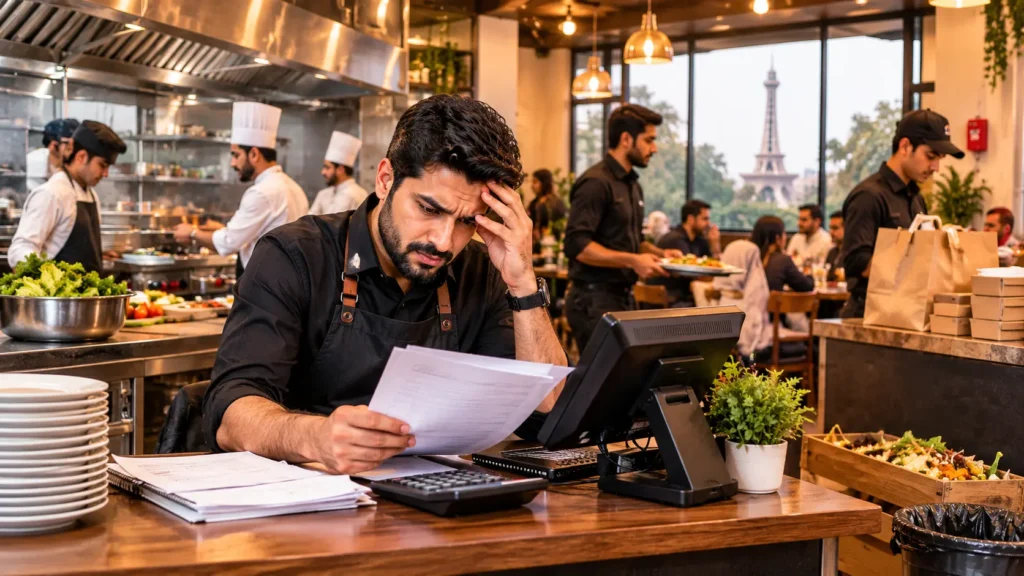
The most common restaurant operational problems in Lahore are stock that does not match the records, food cost that creeps up, orders scattered across channels, slow kitchens, staffing gaps, billing and tax mismatches, delivery commissions and food safety inspections. Each one can be measured, fixed with a simple routine, then locked in with restaurant management software.
This guide shows what each problem looks like, what it costs and the first fix to try. Most fixes work best when sales, stock and accounts share one record, so we also show where a cloud-based POS system and restaurant back office software help.
Lahore restaurants face the same pressures as any busy city, plus local ones: Ramadan and Eid peaks, orders arriving on WhatsApp, cash-heavy tills and regular checks from the food and tax authorities. The owners who stay profitable are not the ones who work the longest hours. They are the ones who track a few numbers every week.
Restaurant Operational Problems in Lahore at a Glance
Use this table to spot which problem is leaking money in your restaurant right now.
Problem | Warning sign | First fix | Number to track |
1. Stock does not match records | Ingredients vanish; emergency purchases | Count your top ten items weekly | Stock variance |
2. Food cost creeps up | Same menu price, smaller profit | Update recipe costs when supplier prices change | Food cost % |
3. Orders scattered across channels | Missed or duplicated orders | One order screen for phone, WhatsApp, app and dine-in | Wrong or missed orders per week |
4. Slow, error-prone kitchen | Tickets pile up at rush hour | Send tickets to stations on a screen | Ticket time at peak |
5. Staffing gaps and turnover | Last-minute rota changes | Build the rota from sales by hour | Labour cost % of sales |
6. Billing and tax mismatch | End-of-day totals do not tally | Issue every bill from the POS | Daily POS vs cash gap |
7. Delivery commissions and late riders | Orders rise, profit does not | Work out profit per delivery order | Profit per order |
8. Food safety and licence checks | Hygiene lapses, surprise inspections | Daily checklist built on WHO’s five keys | Checklist completion |
The 8 Restaurant Operational Problems in Lahore and How to Fix Each
1. Stock That Does Not Match the Shelf
Ingredients disappear through over-portioning, spoilage, theft and recording errors. Because nobody counts, the loss shows up only as a smaller profit at month end.
how do you fix restaurant inventory management issues? Count the same ten high-value items on the same day every week, compare the count with what your sales should have used, and investigate any gap above a limit you set. Link every dish to a recipe so each sale deducts its ingredients.
- Pick a variance limit, for example 3% on meat and dairy, and act when you pass it.
- Log every waste item with a reason: spoilage, spill, return or staff meal.
- Set a reorder level per ingredient so you stop buying by guesswork.
Software makes this routine. Restaurant inventory management software tracks stock in real time, deducts ingredients from POS orders by recipe, and records waste and variance by reason, station and shift.
2. Food Cost That Creeps Up Without Warning
Supplier prices move, but menu prices stay put. When recipe costs are not updated, your margin shrinks quietly on your best sellers.
how do you calculate food cost percentage? Add opening stock to purchases, subtract closing stock to get the cost of goods sold, divide it by food sales and multiply by 100. As an illustration only, PKR 400,000 of ingredients used on PKR 1,000,000 of food sales is a 40% food cost.
- Record the last price paid for every ingredient.
- Re-cost your ten best-selling dishes every month.
- Review any supplier price jump before you reorder.
See how back office teams monitor vendor pricing, and how procurement software for restaurants keeps purchase orders and supplier price history in one place.
3. Orders Scattered Across Phone, WhatsApp, Apps and Dine-In
In Lahore, an order can arrive as a phone call, a WhatsApp message, a delivery app ticket or a walk-in. When each channel has its own notebook or tablet, orders get missed, retyped or duplicated.
how do you manage restaurant order management problems across channels? Bring every channel into one order screen linked to your POS and kitchen display, so each order is entered once and tracked until it is served or delivered. Count missed and wrong orders weekly to see the cost.
- Count orders by channel for two weeks before changing anything.
- Retire side notebooks and personal phones used for orders.
- Send guests an order confirmation and a status update.
Order management software keeps every channel in one list. Phone orders can run through a restaurant call center that takes calls in English, Urdu and Punjabi and syncs orders with the POS and kitchen display, while WhatsApp AI ordering handles chat orders. Our guide to connecting online orders to your POS shows the full flow.
4. A Slow Kitchen and Wrong Orders at Rush Hour
Paper tickets get lost, handwriting gets misread and one station waits on another. Guests feel it as long waits and cold food, and you pay for it in remakes.
how do you speed up a restaurant kitchen at peak time? Send each order to the right station on a screen, show ticket age with a timer, and agree a target ticket time for Friday dinner and weekend lunch. Remove items that routinely hold up the line.
- Measure ticket time for one full peak service before you change anything.
- Run a prep list before every shift so stations start stocked.
- Review the five slowest dishes each week and simplify or reprice them.
A kitchen management system replaces paper tickets with station screens, so the kitchen sees each order the moment it is entered.
5. Staffing Gaps, Turnover and Unclear Roles
Rotas set on WhatsApp, verbal shift swaps and shared till logins make labour the hardest big cost to see. Missing staff at the peak and idle staff in the afternoon both cost money.
how do you reduce restaurant staffing problems? Build the rota from sales by hour instead of habit, keep attendance in one record, give each role its own login, and compare labour cost with sales every week.
- Pull the last four weeks of sales by hour and staff the real peaks first.
- Mark Ramadan, iftar and Eid weeks before you set the rota.
- Ban shared till PINs so every void and discount has a name on it.
Our guide to restaurant employee management covers rotas, attendance and payroll hours. Role-based access and labour cost reporting inside restaurant accounting software show who can do what and what staff cost against sales.
6. Billing, Tax and Invoice Mismatches
Manual bills, unapproved discounts and end-of-day totals that do not match cash and card sales are the usual signs. Add reporting rules from the tax authorities and the paperwork becomes a daily job.
how do you avoid billing and tax mismatches in a restaurant? Issue every bill from the POS, require manager approval for voids and discounts, and compare POS totals with cash and card totals every night. If your outlet must report to the FBR or your provincial revenue authority, check that your POS sends invoices in the required format.
- Close the day with a three-way check: POS, cash drawer, card machine.
- Review voids and discounts by cashier each week.
- Keep one named person responsible for tax filing records.
CherryBerry’s FBR POS invoicing system page explains FBR-integrated invoicing from the till, including invoice numbers and QR codes for Tier-1 restaurants.
7. Delivery Commissions and Late Riders
Delivery adds orders and can still cut profit. Platform commission, packaging, rider cost and refunds are rarely added up per order, so owners feel busy but not richer.
how do you know whether delivery is profitable? Take the order value, subtract the platform commission, packaging, rider cost and refunds, then subtract the food cost of the items. If what is left is thin or negative, change the menu, the price or the channel.
- Calculate profit per order for your ten most common delivery baskets.
- Track late deliveries and refunds by platform and by rider.
- Give regulars a direct way to order so repeat orders skip the commission.
Compare the options in our guide on 3rd-party delivery apps vs your own rider app. A branded online ordering app and a restaurant rider app keep the order, the rider and the customer data on your own channel.
8. Food Safety Checks and Licence Paperwork
In Punjab, the Punjab Food Authority (PFA) licenses and inspects food businesses. A hygiene lapse or missing paperwork can mean fines or a sealed outlet, and a closed outlet earns nothing.
how do you stay ready for food authority inspections? Keep your licence and records current, run a daily hygiene checklist built on WHO’s five keys to safer food, and log temperatures, cleaning and staff training. Treat the checklist as part of opening and closing, not a once-a-month task.
The five keys: WHO’s manual lists them as keep clean, separate raw and cooked, cook thoroughly, keep food at safe temperatures, and use safe water and raw materials. Turn each key into two or three tick-box checks for your own kitchen.
- Assign one person per shift to sign the checklist.
- Record fridge and hot-holding temperatures at fixed times.
- Keep delivery receipts and waste records ready to show what came in and what was discarded.
Which Restaurant Operational Problem Should You Fix First?
You cannot fix all eight at once. Score each problem by how much money it costs a month, how often it happens and how quickly you can fix it. Start with the highest score.
how do you prioritise restaurant management problems? Start with the problem that loses the most money and takes the least time to fix. For most restaurants that is stock and food cost, because the first fix is a weekly count and a recipe update.
before you buy anything, record a four-week baseline: food cost %, labour cost %, wrong or missed orders, ticket time at peak and the daily POS vs cash gap. Without a baseline you cannot tell whether a new routine or tool worked.
Restaurant Management Solutions: How Software Solves These Problems
Spreadsheets and notebooks break when you add a second branch, a delivery channel or a new cashier. Restaurant management software joins the till, kitchen, stock and accounts so one entry updates everything.
- Stock and food cost: sales deduct ingredients by recipe, and purchases update cost.
- Orders: every channel lands on one screen and flows to the kitchen.
- Staff and control: roles limit who can void, discount or open reports.
- Reports: branch-wise and consolidated sales, cost and profit in one dashboard.
what should you look for in restaurant management software in Pakistan? Look for a cloud POS that links to inventory, kitchen and online orders, Urdu-friendly workflows, invoicing that matches local tax rules, multi-branch reports and data you can export. Then compare the full monthly cost, including onboarding.
Ask every vendor these five questions before you commit:
- Does the POS deduct stock by recipe, or only record items sold?
- Do phone, WhatsApp and online orders land in one place?
- Can it issue invoices in the format your tax authority needs?
- Can you see every branch in one report?
- Who owns the data, and can you export it if you leave?
What Is Different About Restaurant Operations in Lahore
Most of these are common restaurant problems in Pakistan, but local conditions change how much each of these restaurant operations challenges hurts.
- Cost pressure is real and public. A 2023 Express Tribune report quoted the chairman of the All Pakistan Restaurant Association on heavy taxes, licensing fees and restricted dinner hours, and an operator who said sales at some restaurants and chains had fallen by up to 40%. The report is from 2023, so compare it with your own books.
- Ramadan and Eid reshape demand. Iftar and Eid weeks need earlier prep, bigger orders and a different rota.
- WhatsApp is a real ordering channel. If chat orders are copied by hand into the POS, mistakes are certain.
- Multi-branch groups need one view. Owners with outlets in Gulberg, DHA, Johar Town and other areas need sales, stock and cost for every branch in one report, not three spreadsheets.
- Authorities inspect. The PFA publishes its licence process online, and food operators apply with identity and business documents. In one Ramadan inspection round reported by the PFA, teams sealed three restaurants in Gulberg for poor hygiene, substandard ingredients and failing to follow instructions, and fined two others.
A 30-Day Plan to Fix Restaurant Operational Problems
- Week 1: record the baseline numbers and count your top ten ingredients.
- Week 2: update recipe costs, set reorder levels and move all orders onto one screen.
- Week 3: build next week’s rota from sales by hour and start the daily hygiene checklist.
- Week 4: compare your numbers with the baseline, then choose what to automate first.
If you want these steps running inside one system, book a free demo and we will walk through your own menu and branches.
How CherryBerry RMS Helps Lahore Restaurants
CherryBerry RMS runs the till, kitchen, stock, accounts and ordering channels in one cloud system. Its service pages document:
- A cloud POS that links to inventory, kitchen display and online orders.
- Recipe-driven stock deduction, reorder points, purchase orders and waste and variance
- Branch-wise and consolidated reports with profit and loss
- A call center that takes orders in English, Urdu and Punjabi, plus WhatsApp AI ordering and a rider app.
- FBR POS invoicing for Tier-1 restaurants.
See the full list of CherryBerry RMS features.
Conclusion: Fix the Number, Then the System
Restaurant operational problems in Lahore rarely come from one big mistake. They come from small leaks: a missed count, an old recipe cost, a lost ticket. Track the numbers in the table above, fix the biggest leak first, then let software keep the routine running.
See Orders, Stock and Cost Working in One SystemCloud POS, kitchen display, inventory and accounting in one system, built for restaurants in Lahore and across Pakistan. |
Key Takeaways
- The eight problems are stock, food cost, order channels, kitchen speed, staffing, billing and tax, delivery profit and food safety.
- Start with a four-week baseline, then fix the biggest money leak first.
- In Lahore, plan for Ramadan and Eid peaks, WhatsApp orders and authority checks.
Frequently Asked Questions
What are the most common restaurant operational problems in Lahore?
The most common are stock that does not match records, rising food cost, orders scattered across phone, WhatsApp and apps, slow kitchens, staffing gaps, billing and tax mismatches, delivery commissions and food safety checks.
How do restaurant operational problems affect profit?
They leak money in small amounts: wasted stock, outdated recipe costs, remade orders, overstaffed shifts and delivery orders that earn little. Tracking food cost, labour cost and ticket time shows where the leak is.
How can a restaurant reduce food cost and waste?
Count key ingredients weekly, link each dish to a recipe, update recipe costs when supplier prices change and log every waste item with a reason. Review variance by item and by shift.
What is the best way to manage orders from phone, WhatsApp and delivery apps?
Use one order screen linked to the POS and kitchen display, so every order is entered once and tracked to completion. Count missed and wrong orders weekly to measure improvement.
How do I reduce staff turnover and scheduling problems?
Publish the rota early, build it from sales by hour, give clear roles and logins, and review labour cost against sales weekly. Treat repeated last-minute changes as a planning problem, not a staff problem.
Do restaurants in Lahore need a PFA licence?
Food operators in Punjab apply for a licence through the Punjab Food Authority, and the category depends on the business. Check the current requirements with the PFA before you open or expand.
Is restaurant management software worth it for a small restaurant?
Often yes, if you start with the problem that costs most. A single outlet usually gains first from POS-linked stock and food cost tracking, then adds kitchen screens and online orders.
How much does restaurant management software cost in Pakistan?
It depends on branches, users and modules, so prices vary widely. Compare the full monthly cost, including onboarding and any POS link, and get it in writing.
What are the biggest restaurant business challenges in Pakistan?
Owners describe rising ingredient, utility and tax costs, thin margins, staff turnover, delivery commissions and compliance checks. Fixing the operational leaks above protects margin before you raise prices.
Which KPIs should a restaurant owner track every week?
Track food cost %, labour cost % of sales, stock variance, wrong or missed orders, ticket time at peak, the daily POS vs cash gap and profit per delivery order.
How long does it take to fix restaurant operational problems?
A basic baseline and the first routines take about 30 days. Allow 60 to 90 days of data before judging whether a new routine or tool has improved your numbers.