

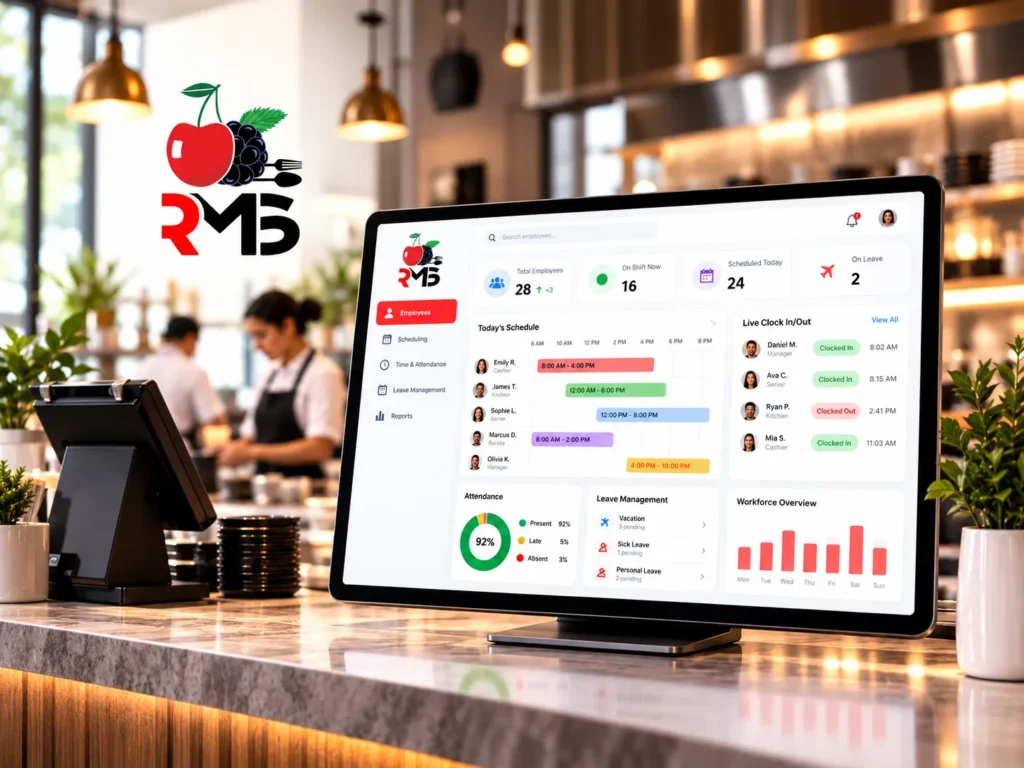
Restaurant employee management software keeps staff records, shifts, attendance, leave and payroll hours in one system, so managers stop running the team from spreadsheets and WhatsApp groups. Linked to the POS, it also shows labour cost against sales and limits what each role can do at the till.
This guide covers the features that matter, how to choose and what changes in Pakistan. It works best when it shares data with the till, so we also cover how it links to a cloud-based POS system.
Running a restaurant business is not an easy feat for restaurateurs as they have to deal with many day-to-day challenges including Restaurant Employee Management. Luckily, automation has made it easy to monitor and track when employees clock-in and out as well as their leave record. Restaurateurs can easily manage and deploy their workforce and can focus on business development.
Restaurant Staff Management was the most daunting task for restaurant administration in the past as so many employees’ worked in different departments at different times round the clock. Thus, it was hard for the administration to manage and monitor the staff properly. However, Restaurant Staff Management Software has now made it easy to track the whereabouts of every staff member. This has reduced the chances of manual deception and streamlines the payroll accuracy.
No more staff needs to be deployed separately to maintain the employee’s data as Restaurant Employee Management software keeps the entire data safe within it. In fact, it serves as a central repository wherein all employee information, contact details, training, working hour details and leaves record remain available.
What Is Restaurant Employee Management Software?
Restaurant employee management software is a digital system for restaurant team management: who works, when, for how long, on what pay and with what access. It replaces the paper register, the spreadsheet rota and the WhatsApp shift message with one record per employee.
It overlaps with staff scheduling software, time and attendance systems and restaurant HR software (HRMS). Groups with several branches add forecasting and central reporting, sometimes called restaurant workforce administration.
Which Restaurant Staff Management Problems Does It Solve?
Problem | What it looks like | What changes |
Schedule conflicts | Two people on one station, nobody on another | Availability and leave are checked when the rota is built |
Late arrivals and no-shows | You find out after the shift has started | Clock-in times show gaps early |
Attendance disputes | Register against memory at month end | Time stamps give one record both sides can check |
Payroll errors | Hours retyped from a register into a sheet | Approved hours flow to payroll |
Unclear permissions | Anyone can void a bill or give a discount | Roles limit sensitive actions to managers |
Uneven branch cover | Short at one branch, overstaffed at another | One view of staff across branches |
Why turnover makes this harder: every exit means a new hire to schedule and train. In the US, accommodation and food services had a monthly quits rate of 3.5% in August 2026, against 2.1% for private industry. Track your own exits too.
Core Features of Restaurant Employee Management Software
Look for these, in this order:
- Employee database management: one searchable profile per person, covering employee record management, employee information management and centralised employee records.
- Employee shift planning and staff rota management, with availability and shift swaps (sometimes sold as shift allocation software).
- Employee clock-in and clock-out with digital attendance tracking.
- Employee leave tracking and employee timesheet management, which support payroll accuracy.
- Workforce cost management: hours and wages against sales by shift and branch.
- Roles and permissions, and staff communication management through rota notifications.
Start with the first four, because restaurant labour management is decided by the rota and the time clock. Add staff performance monitoring and employee productivity tracking later.
What Restaurant Staff Management Software Does Every Day
Here are a few other advantages of integrating staff management software with restaurant POS systems.
Simplifies Staff Scheduling
Scheduling is the biggest challenge for restaurant administration. Restaurateurs have to deal with the variations of both busy and down times depending on the customer’s arrival. They have to deploy the employees for answering phone calls, greeting customers, serving guests and handling the meals. In the past spreadsheets were used to keep all this information safe so there were a lot of chances of human error. However, now administration can easily create complex and complicated schedules with the help of automation. Managers can easily send Restaurant Staff Positions schedules to employees via email or text communication.
how do you create a restaurant staff schedule? Start from expected demand: covers and sales by hour and day. Match each shift’s stations to staff availability and leave, publish the rota early, then compare planned hours with actual hours after each week and adjust.
- Start with staff availability management: record availability, approved leave and the weekly off day.
- Fix how many people each station and hour needs, using POS sales by hour and booked tables from your table reservation system.
- Publish the rota to staff phones and route shift swaps through the manager.
- Compare planned and clocked hours each week, then adjust the template.
Expert note: schedule to demand, not to habit. Pull the last four weeks of POS sales by hour, mark the real peaks (Friday dinner, weekend lunch, iftar and Eid during Ramadan) and staff those hours first.
Avoid copying last week’s rota blindly or letting staff swap shifts verbally.
How to Track Restaurant Employee Attendance
how do you track restaurant employee attendance? Record every shift with a time stamp at clock-in and clock-out, tied to the employee’s profile and branch. Use a PIN or mobile app at the restaurant, review late arrivals and missed punches daily, and approve hours weekly before payroll. Keep one register only.
Choose the method that fits your team:
- Paper register: free, but easy to alter and retyped for payroll.
- PIN at the till: simple and tied to the branch, but ban shared PINs.
- Mobile app: uses staff phones, but location checks need consent.
- Biometric device: hard to fake, but it costs hardware and needs a backup.
Set the rules first: the lateness grace period, what counts as a missed punch and who approves corrections. A restaurant employee tracking system should count employee working hours from approved punches only.
Helps to Reduce Delays in Payroll Process
Employee management system has simplified the management of staff as well as payroll process. Restaurant administration can easily track the working hours and leave records of all employees and can avoid delays in payroll process. This saves both time and money for the restaurant administration. Moreover, the Restaurant Staff Management system keeps a record of all issues and performance of the employees.
Restaurant staff payroll tracking comes down to four checks on every pay run: regular and overtime hours, advances and deductions, employee work-hour reporting by branch and shift, and labour cost as a share of sales.
Good restaurant payroll management software keeps all four on one record. When payroll feeds labour cost reporting inside the accounts, the profit and loss shows staff cost, which is what restaurant accounting software is for.
Keep Employees Well-Informed
Latest management systems come with cloud-based functionality that means all data stored in the cloud. Administration can access this data anytime, anywhere from any device. This system also allows the restaurant employees to access schedules from anywhere through various devices. Furthermore, restaurant administration can keep their staff well-updated about the coming events so they remain aware and ready in advance.
A rota staff can open on their phones ends the late-night “which shift am I on?” messages.
Allow Deployment of Staff at Multiple Locations
If you are among those restaurant owners that own multiple restaurants then you can easily deploy the right employees at each location. Cloud-based Employee Management Systems allow you to make changes in staff schedules and locations according to demand. All the information can be shared with the staff so chances of confusion or mistakes are lower.
A cloud-based employee management system for restaurants gives every branch the same records and rules:
- One employee profile for staff deployment across branches, with branch-level permissions.
- Central rules for overtime and leave, and labour cost per branch on the same basis.
Roles and Permissions: Control Who Can Do What at the Till
Staff management also means deciding who can void a bill, give a discount or open reports. A good setup has three levels: cashiers process bills, shift managers approve voids and discounts, and owners see everything, including payroll. In a kitchen management system, cooks update order status and have no reason to open sales or payroll.
Expert note on employee data: treat the employee file like financial data. Give access by role, remove it the day someone leaves and keep an export you control. Ask any vendor who owns the data if you cancel.
What Changes for Restaurants in Pakistan
The functions are the same everywhere, but local conditions change how much each one matters for restaurant employee management software in Pakistan. Rotas often live in WhatsApp and registers, which cannot be audited when a dispute arrives.
Working hours and overtime have a legal side
In Punjab, hours and overtime for restaurants are covered by the Punjab Shops and Establishments Ordinance, 1969. Other provinces have their own rules, so check the one that applies to you.
What the Ordinance says (Punjab): it lists restaurants, eating houses and cafes (section 2). Adults may work nine hours a day and 48 hours a week (section 8), overtime is paid at double the ordinary rate (section 9), and every worker gets one weekly holiday (section 6). Employers must keep the prescribed records (section 23). The portal notes later amendments, so confirm the current text.
Payroll records, cash wages and EOBI
what was agreed and repaid.
Statutory contributions: the Ministry of Overseas Pakistanis and Human Resource Development states that every establishment with ten or more employees must register with the Employees’ Old-Age Benefits Institution (EOBI), with contributions based on the minimum wage notified by the Federal Government.
Ramadan, Eid and multi-branch groups change the rota
Demand peaks at iftar and around Eid, so plan the rota weeks ahead. Multi-shift workforce scheduling gets harder when a branch runs lunch, iftar and late-night service, and groups in Lahore, Karachi and Islamabad need one view of staff across branches.
How to Choose Restaurant Employee Management Software
The best restaurant employee management software is the one your managers will actually use every day, not the one with the longest feature list. That holds whether you are shopping for restaurant payroll and attendance software or a full staff platform.
how much does restaurant employee management software cost? Vendors charge per user, per employee, per location or a flat monthly fee, and some quote only on request. Compare the full monthly cost for your headcount and branches, including payroll, onboarding and any POS link, and get it in writing.
Ask these questions before you commit:
- Does it cover rota, attendance, leave and payroll hours, or only one?
- Does it connect to your POS, so labour can be compared with sales?
- Does it handle several branches, overtime, advances and deductions?
- Who owns the data, and can you export it?
- What does onboarding include, and what is the full monthly cost?
PKR prices depend on headcount, branches and modules, so we have not listed any. Pilot at one branch for two weeks first.
How CherryBerry RMS Handles Restaurant Staff Management
CherryBerry RMS keeps staff access and labour cost inside the same cloud system as the POS and the accounts. Today that means:
- User roles for cashiers, shift managers and owners: a cashier can process a bill, but only a manager can void one.
- Role-based access that limits sensitive data, including payroll detail in the accounts, to authorised people.
- Payroll feeding labour cost reporting, so the profit and loss shows staff cost.
- Branch-wise and consolidated reports for every branch in one place.
- Staff, inventory, billing and orders from one dashboard.
See the full list of CherryBerry RMS features.
Conclusion: Start With the Problem That Costs You Most
To be brief, the employee management system facilitates restaurant administration to manage their employees effortlessly. So invest in this system to save your time and money.
Start with attendance and payroll hours at one branch, then add scheduling and more branches. Book a free demo to see staff roles, payroll-linked labour cost and branch reporting working with your POS.
Key Takeaways
- Restaurant employee management software puts records, rota, attendance, leave and payroll hours in one system.
- Start with scheduling, attendance and payroll hours, then add performance tools.
- In Pakistan, check your province’s hours and overtime rules and record advances and deductions.
Frequently Asked Questions
What is restaurant employee management software?
It is a system that stores employee records and handles shift scheduling, attendance, leave tracking and payroll hours for restaurant staff. Linked to the POS, it also shows labour cost against sales.
How does employee management software help restaurants?
It removes retyping and guesswork: rotas follow availability and demand, attendance is time-stamped, approved hours flow to payroll, and permissions stop unauthorised voids.
How do I track restaurant employee attendance?
Use a time-stamped clock-in and clock-out tied to each employee and branch, through a POS PIN, a mobile app or a biometric device. Review late arrivals daily and approve hours weekly.
How do I create employee schedules for a restaurant?
Forecast demand from POS sales and bookings, match stations to availability and leave, publish the rota early and compare planned with actual hours weekly.
How do I manage restaurant staff across multiple branches?
Keep one employee profile assignable to several branches, set branch-level permissions, apply central overtime and leave rules, and compare labour cost per branch.
How much does restaurant employee management software cost?
It depends on the pricing model: per user, per employee, per location, flat monthly or custom quote. Compare the full monthly cost for your headcount and branches, including onboarding.
Does a small restaurant need employee management software?
Not every module on day one. A single restaurant usually gains most from digital attendance and payroll hours, then adds scheduling and leave.
Is employee data safe in cloud staff management software?
It depends on the vendor. Look for role-based access, encrypted transmission, backups and a data export, and limit payroll detail to a few named roles.