

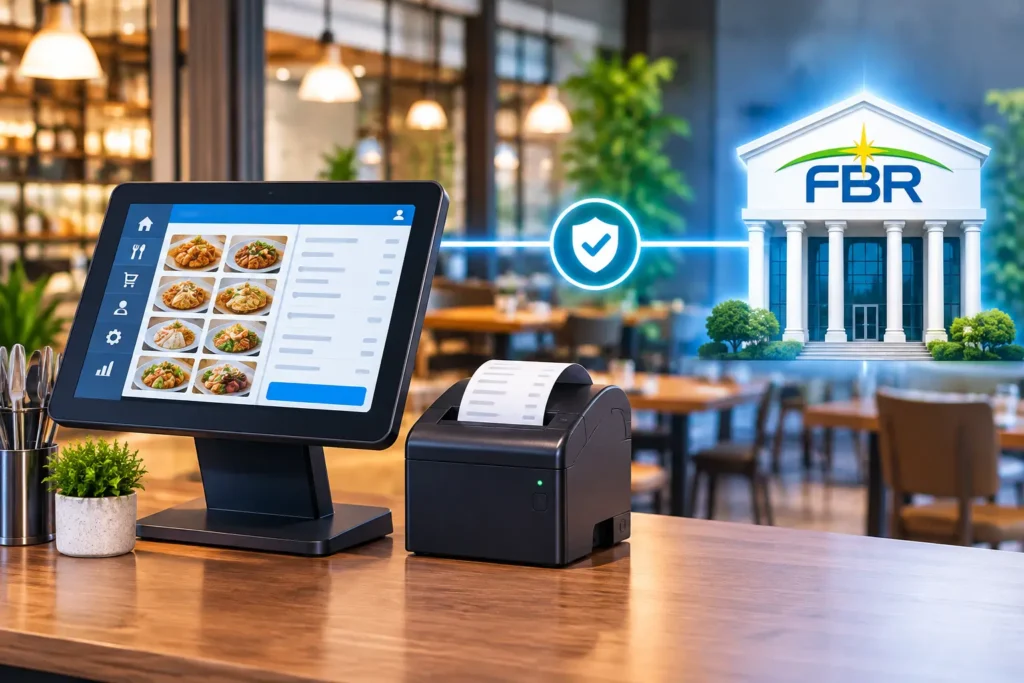
FBR POS integration means your restaurant’s billing system sends every sale to the Federal Board of Revenue as it happens, and the receipt carries an FBR invoice number and a QR code. This guide explains who has to do it, how it works, and what the rules say if you do not.
The rules depend on your registration, your type of premises and your province, so every important point below names its source. If you want a billing system that already prints FBR invoices, see how CherryBerry handles it on the FBR POS invoicing system page, then come back to check the rules for your own outlet.
What Is FBR POS Integration?
FBR POS integration is a live connection between your POS software and the FBR’s computer system. Each sale is sent to the FBR, which returns a unique invoice number. The receipt shows that number and a QR code, so a customer can check the invoice.
The legal base is section 3(9A) of the Sales Tax Act, 1990. Specifically, it says Tier-1 retailers must connect their outlets to the Board’s system for real-time reporting of sales.
This is different from printing a normal tax receipt. For instance, a receipt from ordinary billing software never reaches the FBR, while an integrated invoice does, and that is why the FBR can see it.
Does Your Restaurant Have to Integrate?
There is no single yes or no for every restaurant. In fact, three sets of rules can apply, and they overlap. So read all three before you decide.
Tier-1 retailer rules under the Sales Tax Act
First, the FBR’s own enforcement notices speak about “Tier-1 retailers and restaurants” together. Second, the law defines a Tier-1 retailer in several ways. For example, it includes a unit of a national or international chain, a retailer in an air-conditioned shopping mall or plaza, a retailer whose electricity bill is above a set threshold, and a retailer who has taken a card payment machine from a bank. The FBR’s POS legal booklet prints the full definition and the penalty clauses.
In addition, the Finance Bill 2026 proposed adding retailers with an annual turnover of Rs 200 million or more. Therefore, check the final wording of the Act with your tax advisor.
The Income Tax online integration list
First, on 22 March 2024 the FBR issued S.R.O. 428(I)/2024, which amended Chapter VIIA of the Income Tax Rules. The list starts with restaurants operating in an air-conditioned facility, and the integration date was 1 July 2024. KPMG Pakistan’s summary of the S.R.O. 428(I)/2024 rules shows the full list and its exclusions.
Then, in February 2026 the FBR published a draft, S.R.O. 288(I)/2026, to replace that chapter with a wider list that also names restaurants. However, KPMG notes a draft is not effective until a final notification is issued, and provincial revenue authorities asked the FBR to hold it back. As a result, as of 24 November 2026 I could not find a final notification, so treat it as a draft.
E-invoicing for sales tax registered persons
S.R.O. 709(I)/2025 of 22 April 2025 asked registered persons to connect their invoicing systems to the FBR through a licensed integrator or PRAL. However, the dates were revised more than once. For example, the latest I found, S.R.O. 1852(I)/2025 of 24 September 2025, set registration, testing and issuance dates between November and December 2025. Therefore, if your restaurant is registered for sales tax, ask your tax advisor whether these dates already apply to you.
Punjab and Sindh rules
In Punjab, the Punjab Revenue Authority runs an Electronic Invoice Monitoring System (EIMS). Recently, ARY News reported on 11 November 2026 that hotels, restaurants, coffee shops and marriage halls must connect to it, with reported fines from Rs 400,000 to Rs 1 million. The report did not state a deadline, so confirm it with the PRA. Meanwhile, in Sindh, the Sindh Revenue Board sets its own rules for restaurants, so Karachi outlets should check with it directly.
A quick self-check
- Are you registered for sales tax with the FBR?
- Does your restaurant operate in an air-conditioned space or an air-conditioned mall?
- Is it part of a chain, or do you use a bank card payment machine?
- Which province taxes your restaurant service: Punjab, Sindh or the federal capital?
- Has your accountant or the FBR already sent you a notice?
Therefore, if you answer yes to any of these, assume integration matters to you and get written advice.
How Many Restaurants Have Already Integrated?
The FBR’s list of integrated retailers, updated up to 30 June 2026, shows 13,454 integrations across 37,122 branches. In particular, 1,093 of these are restaurants with 1,716 branches. So a large number of chains have already done it, and the FBR keeps count.
How FBR POS Integration Works, Step by Step
Here is the usual path for a restaurant. Your POS vendor or integrator handles the technical parts, but you should know what each step is.
- Confirm your category and registration. Use the self-check above and your STRN or NTN details. Decide which authority applies: the FBR, the PRA or the SRB.
- Choose your route. Integration goes through a licensed integrator or PRAL. The next section explains the difference.
- Register your outlets and POS. Have your sales tax registration details ready. Also, each outlet and POS terminal needs to be declared. Your integrator guides you through the FBR portal.
- Connect and test. The FBR publishes one document on its site, “Technical Documentation for Digital Invoicing API Integration”. The page lists no sandbox or dates, so ask your integrator for test access. In addition, the e-invoicing rollout used three stages: register, test, then go live.
- Go live and check the first invoices. Every receipt should carry an FBR invoice number and a QR code. Then test a few, including a discount, a refund and a delivery order.
- Watch it every day. Check that the connection is up and that no invoice is rejected or missing. Finally, the penalties section shows why this matters.
Licensed Integrator or PRAL: Which Route?
Dawn reported in April 2025 that integration must go through a licensed integrator approved by the FBR, or through Pakistan Revenue Automation Limited. In addition, the FBR told the Federal Tax Ombudsman in 2025 that PRAL’s integration service is free under S.R.O. 69(I)/2025. Alternatively, a licensed private integrator is the other route, and its charges are a matter between you and the integrator.
In addition, the FBR’s legal provisions page lists S.R.O. 1279(I)/2021, a service charge of Re 1 per invoice issued through an integrated POS. Ask your integrator whether and how that applies to you. Whichever route you pick, get the price in writing. For the wider cost of a POS system, see our guide to restaurant POS software price in Pakistan.
Therefore, ask your vendor in writing which route it uses and for evidence of its licence where one is required. A label such as “FBR ready” is not proof.
See the Cloud POS for Restaurants → /cloud-based-pos-system-restaurant/
What Your Customer Sees: Invoice Number, QR Code and Verification
In fact, a customer can check any integrated invoice. The FBR’s verification page gives two ways.
- Tax Asaan app: open the “FBR POS” menu, tap “Verify Invoice”, then enter the FBR invoice number or scan the QR code on the receipt. The app shows whether the invoice is verified or unverified.
- SMS: alternatively, send the invoice details to 9966 in this format: INV, a space, your CNIC number, a space, the FBR invoice number.
However, the FBR page describes only the app and SMS, not a website method.
The FBR also started a POS Prize Scheme on 25 October 2024, first for Tier-1 restaurants in Islamabad. It rewards citizens who report fake invoices. This is why a working QR code matters: your customers may check it.
Penalties and Sealing: What the Rules Say
Section 33 penalties
Penalties sit in section 33 of the Sales Tax Act. The FBR booklet lists these for integrated persons and for those who should integrate but do not.
- Fake or missing invoice details: issuing invoices without a valid number, barcode or QR code, or with duplicate or counterfeit ones, carries a penalty of Rs 500,000 or 200% of the tax involved, whichever is higher. The premises may also be sealed.
- Not integrating: the booklet version lists escalating penalties of Rs 500,000, then Rs 1 million, Rs 2 million and Rs 3 million at 15 day gaps. The Finance Act 2026 revised section 33 from 1 July 2026. Reports describe a penalty of up to Rs 1 million, then up to Rs 5 million if the default continues a month later, plus sealing. Read the current text of section 33 before quoting a figure.
When an outlet can be sealed
In addition, the sealing rules (S.R.O. 252(I)/2022, amended by S.R.O. 164(I)/2025) add practical limits. For example, a Tier-1 outlet can face sealing if it issues unverified invoices, if its POS stays disconnected from the FBR database for more than 48 hours, if offline invoices are not entered within 24 hours, or if the device fails to keep records while offline. After the penalty is paid, the de-sealing order is due within 24 hours.
What enforcement has looked like
These are real actions. For example, in October 2024 the FBR sealed two Islamabad restaurants for fake invoices and fined each Rs 0.5 million. Later, in June 2025 the Federal Tax Ombudsman directed the FBR to stop sealing Tier-1 outlets until POS technical problems were fixed, so check whether that direction still applies.
In short, the lesson for a restaurant is simple: uptime and offline handling matter as much as the first setup.
Questions to Ask Before You Choose an FBR-Ready POS
Therefore, use these questions with any vendor, including us. Ideally, a good vendor answers them with a live demo, not a brochure. If you are still comparing systems, our guide to the best POS software in Pakistan shows how to run that test.
- Which route do you use, a licensed integrator or PRAL, and can you show written proof?
- Can you print a live test invoice with an FBR number and QR code, and show me it verifies in the Tax Asaan app?
- What happens when the internet or the FBR service is down? Does the POS store the invoices and send them within 24 hours?
- How are discounts, voids and refunds sent? The FBR has issued a clarification on discounts on standardised invoices (S.R.O. 1006(I)/2021).
- Do delivery, WhatsApp and call center orders also get FBR invoices?
- How do you set up several branches, and what does each additional outlet cost?
- Who pays any per-invoice service charge, and what other fees apply?
- Who fixes a rejected invoice, and how fast is support?
- Does the system also cover the PRA or SRB for my province?
Common Mistakes
- Treating “FBR ready” as proof of integration.
- Integrating one branch and forgetting the others.
- Ignoring the provincial authority while following only the FBR.
- Never testing what happens offline until the internet fails during dinner service.
- Not keeping the vendor’s licence evidence, support contacts and test results on file.
Key Takeaways
- FBR POS integration sends each sale to the FBR in real time and prints a verifiable invoice number and QR code.
- Whether you must integrate depends on three rule sets and your province. Check each one.
- Integration goes through a licensed integrator or PRAL. PRAL’s service is free according to the FBR.
- Penalties and sealing rules include 48 hour disconnection and 24 hour offline entry limits, and section 33 penalties were revised from 1 July 2026.
- Choose a POS by what it proves in a live test, not by a label.
Frequently Asked Questions
What is FBR POS integration?
It is a live link between your POS software and the FBR system. Each sale is reported to the FBR, which returns a unique invoice number. The receipt prints that number and a QR code so customers can verify the invoice.
Is FBR POS integration mandatory for restaurants?
It depends. First, air-conditioned restaurants are listed in S.R.O. 428(I)/2024. Second, Tier-1 retailer rules can apply, and registered persons face e-invoicing rules. Finally, provincial rules also apply. Therefore, confirm your own status with your accountant or the FBR.
How do I integrate my restaurant POS with the FBR?
First, confirm your category, choose a licensed integrator or PRAL, register your outlets and POS, connect and test, then go live and monitor daily. In practice, your POS vendor or integrator handles the technical connection.
What is the difference between a licensed integrator and PRAL?
Both are approved routes. PRAL is the FBR’s technology partner, and the FBR says its integration service is free under S.R.O. 69(I)/2025. In contrast, a licensed integrator is a private company approved by the FBR and sets its own charges.
How much does FBR POS integration cost?
The FBR does not publish one price. PRAL integration is free according to the FBR. However, private integrators charge their own fees. In addition, the FBR lists a Re 1 per invoice service charge under S.R.O. 1279(I)/2021. Therefore, ask for a written quote.
How can customers verify an FBR POS invoice?
Use the Tax Asaan app: open FBR POS, tap Verify Invoice, then enter the invoice number or scan the QR code. Alternatively, send an SMS to 9966 in the format INV, CNIC number, FBR invoice number.
What happens if my POS goes offline?
Under the sealing rules, a Tier-1 outlet can face action if it stays disconnected from the FBR database for more than 48 hours or does not enter offline invoices within 24 hours. Therefore, choose a POS that stores invoices offline and sends them later.
What is the penalty for not integrating?
The Sales Tax Act, section 33, sets penalties and allows sealing. The Finance Act 2026 revised the amounts from 1 July 2026, and reports describe up to Rs 1 million, then up to Rs 5 million. However, check the current text of the Act.
Do restaurants in Punjab and Sindh need separate integration?
Provincial authorities run their own systems. For example, Punjab’s PRA has an Electronic Invoice Monitoring System for restaurants and hotels, and Sindh’s SRB has its own rules. Therefore, check with the authority for your province.
Ready to Check Your Restaurant’s FBR Setup?
Bring your menu, your branch list and your questions from this guide. In return, we will show you a live FBR invoice and answer each question in front of you. Book a Free Demo → /contact-us/