

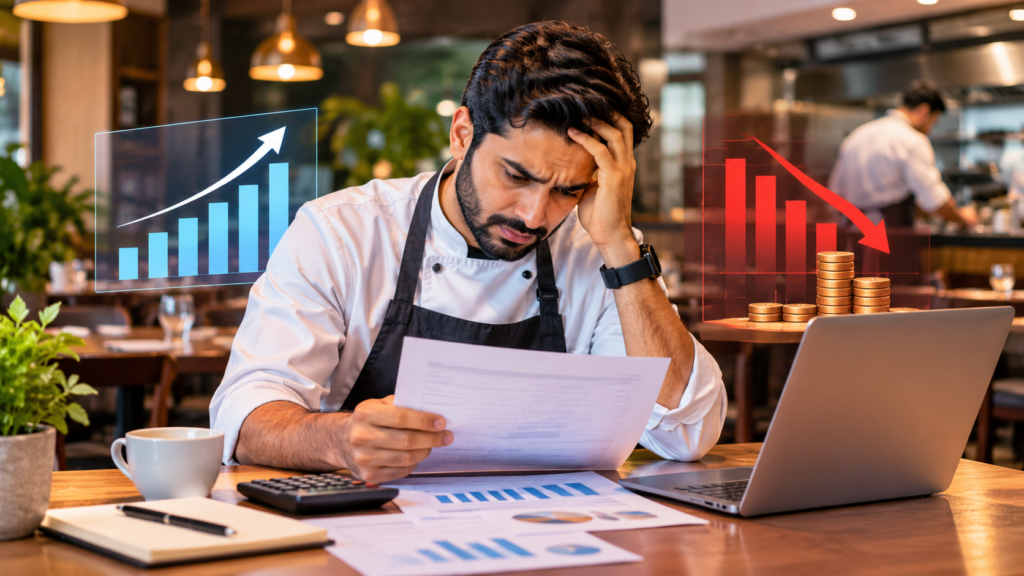
Restaurants end up losing money even when sales are increasing when costs rise faster than sales, or when each extra sale earns less than the one before. The usual causes are food and labour cost creep, discounts, delivery commissions, a menu that sells low-margin dishes and rising overheads.
Higher sales feel like proof that the business is healthy, but sales only show how busy you are. Profit shows what is left. This guide gives you seven reasons the gap opens, a five-number check to find your own leak and the fixes to try first. Most of those numbers come straight out of a cloud-based POS system for restaurants that is linked to stock and accounts.
It comes from the CherryBerry RMS team in Lahore. We build restaurant software, so we know which numbers matter and which ones only look good.
Why Profit Falls When Sales Rise
- Sales are not profit. Profit is what remains after food, labour, rent, utilities, fees and every other cost.
- The usual causes: food cost creep, labour growing faster than sales, discounts and comps, a low-margin menu mix, delivery commissions, rising overheads, and growth that adds cost before it adds sales.
- Thin margins magnify small cost rises. In a National Restaurant Association analysis of an average independent US restaurant before the pandemic, only about 5 cents of pre-tax profit was left from each sales dollar.
- Profit is not cash. A restaurant can show a profit and still be short of cash.
- The fix starts with five numbers: food cost, labour cost, prime cost, discounts and comps, and profit per delivery order.
Why Do Restaurants Lose Money When Sales Go Up?
because restaurant profit margins are thin, so a small rise in costs removes a large share of the profit. A busy week does not change that arithmetic.
In the National Restaurant Association’s analysis of an average independent US restaurant before the pandemic, about 33 cents of every sales dollar goes to food, about 33 cents to labour and about 29 cents to other costs such as utilities, occupancy and card fees. That leaves roughly 5 cents of pre-tax profit. The same analysis estimates that total expenses rose about 36% between 2019 and 2026. These are US figures from before the pandemic, so treat them as a guide to how thin margins are, not as a Pakistani benchmark.
Here is why that matters. If your costs rise 3%, that is about 2.85 cents on the 95 cents you spend. It wipes out more than half of the 5 cents you keep.
A simple example in rupees
This is an illustration, not a client story. Say a restaurant has these two months:
- Month 1: sales PKR 1,000,000, costs PKR 950,000, profit PKR 50,000 (5%).
- Month 2: sales up 10% to PKR 1,100,000, costs up 12% to PKR 1,064,000, profit PKR 36,000 (about 3.3%).
Sales rose 10%, yet profit fell 28%. Nobody did anything dramatic. Costs simply grew two points faster than sales, and the thin margin did the rest.
7 Reasons Restaurants Lose Money Even When Sales Are Increasing
Most owners have two or three of these at the same time. Read all seven, then use the check later in this guide to see which ones are yours.
1. Food cost creeps up while menu prices stay put
Supplier prices move all year, but menus change rarely. If the recipe cost on your best sellers is out of date, you keep selling them at a margin you no longer earn. Portion drift and waste make it worse, because extra servings and spoiled stock are bought but never sold.
- Check: compare the food cost your recipes say you should have with what you actually spent.
- Fix: re-cost your ten best-selling dishes every month and count key ingredients every week.
Good POS inventory management deducts ingredients as dishes sell, so the gap is visible. It also helps to monitor vendor pricing and use procurement software for restaurants so a price jump does not reach you as a surprise invoice.
2. Labour grows faster than sales
Rotas built on habit lead to too many people on quiet afternoons and too few at the rush. Overtime, extra hires for a busy month and shared till logins push labour cost up, and the cost stays after the busy month ends.
- Check: labour cost as a percentage of sales, week by week.
- Fix: build next week’s rota from sales by hour, and give every person their own login so every void and discount has a name on it.
3. Discounts and comps buy sales, not profit
A discount feels harmless because the table is full. The arithmetic says otherwise. Take a dish that sells for PKR 1,000 and costs PKR 350 to make, so it earns PKR 650. After a 20% discount it sells for PKR 800 and earns PKR 450. Your profit on that dish fell by about 31%, so you need to sell about 44% more of it just to earn the same total.
- Check: discounts and comps as a percentage of gross sales, by shift and by person.
- Fix: make discounts and voids need manager approval, and end promotions that you cannot show brought in new guests.
Wrong and remade orders are another quiet source of comps. See how a restaurant POS cuts order errors that lead to free replacements.
4. Your menu sells the wrong mix
The most popular dish is not always the most profitable one. If guests keep ordering a low-margin item, sales grow while profit per guest stays flat or falls.
- Check: list each dish with its selling price, cost and margin, then rank by how much profit it earns in total.
- Fix: move high-margin dishes to the top of the menu, trim the ones that sell often but earn little, and adjust the recipe or the price of the rest.
5. Delivery orders earn less than dine-in orders
Delivery adds orders, but not always profit. Here is an illustration. A PKR 2,000 order carries food cost of 35% (PKR 700). If the platform charges a 25% commission (PKR 500) and packaging costs PKR 80, you keep about PKR 720 before labour, rent and utilities. The same order eaten in the restaurant would leave about PKR 1,300 at that stage. Check your own commission rate and cost, because they differ by platform and contract.
- Check: profit per delivery order for your ten most common baskets.
- Fix: price delivery items separately, remove loss-making items from delivery menus and give regulars a direct way to order.
Our comparison of 3rd-party delivery apps vs your own rider app explains the trade-off in more detail.
6. Overheads rise and nobody prices them in
Rent, electricity, gas, repairs, software and card fees grow a little each year. In Pakistan, fuel is a clear example. ProPakistani reported in August 2026 that OGRA raised LPG prices for that month by Rs12.89 per kilogram, adding Rs152.01 to an 11.8 kg cylinder. It also reported that some cafe owners in Karachi are accepting thinner margins, cutting portions or reducing staff to cope.
- Check: list every fixed cost once a quarter and compare it with the same quarter last year.
- Fix: build overhead rises into your menu prices on a schedule, not after the margin has already gone.
7. Growth adds cost before it adds sales
A new branch, a second shift or a bigger team all add cost on day one. Sales take months to catch up. A recent Restaurant Business column argues that when more locations compete for the same diners, total sales rise while sales per location fall.
- Check: profit by branch, not just the combined total.
- Fix: set a break-even target for every new branch or shift, and review it monthly.
If your leaks turn out to be operational (stock counts, slow kitchens, scattered orders), our guide to 8 restaurant operational problems in Lahore covers each fix.
Profit vs Cash Flow: Why a Profitable Restaurant Can Run Short of Cash
profit is what your accounts say you earned. Cash is what is in the bank today. They are not the same thing, so a restaurant can be profitable and still struggle to pay suppliers or staff.
Cash can be tied up in many places:
- Stock bought in bulk that has not sold yet.
- Supplier invoices due before sales settle.
- Loan repayments and owner withdrawals, which do not appear as costs in the profit figure.
- Money spent on a new branch, equipment or renovation.
- Tax and licence payments that arrive in lumps.
Look at your bank balance and at your profit report every week, and look ahead at least a month for big payments. If profit is healthy but cash is always tight, the cause is usually stock, timing or withdrawals, not sales.
How to Find Your Own Leak: The Five-Number Check
Pull the last four weeks of sales and costs, then work out these five numbers. If your POS system and accounts are linked, most of them are already on a report.
- Food cost %: cost of the food you used, divided by food sales, times 100.
- Labour cost %: all labour cost, divided by total sales, times 100.
- Prime cost %: food cost plus labour cost, as a percentage of sales. Many operators use about 60 to 65% as a rule of thumb, but the right target depends on your concept, so start by comparing with your own best month.
- Discounts and comps %: the value of discounts and comps, divided by gross sales, times 100.
- Profit per delivery order: order value, minus commission, packaging, rider cost, refunds and food cost.
Add one more check if you handle cash. Compare the POS total with the cash drawer and card machine every night, because a growing gap points to missed bills, unrecorded discounts or errors.
A 30-minute weekly money check
- Open last week’s sales by day and by item.
- Work out the five numbers above and write them in one sheet.
- Compare each one with the previous four weeks and circle any that moved more than a point.
- Pick the single biggest mover and ask what changed: supplier price, portion, rota, promotion or channel.
- Choose one action for next week and write down who does it.
What to Fix First
You cannot fix all seven at once. Start with the changes that are fast and large.
- Discounts and comps (days): require approval, stop weak promotions.
- Recipe cost and portions (one to two weeks): update costs, weigh portions on the top ten dishes.
- Rota (two weeks): build it from sales by hour.
- Delivery (two to four weeks): price items for delivery and review the channel mix.
- Suppliers and menu mix (monthly): renegotiate, re-rank dishes by profit.
Should you raise prices? Sometimes, yes, especially when costs have risen across your whole menu. But check the leaks first, because a price rise on top of a leaking system only feeds the leak. If you do raise prices, start with high-volume dishes and change them in small steps.
How Restaurant Software Helps, and What It Cannot Do
Software does not create profit. It shows you the numbers early enough to act. A good restaurant system joins the till, stock and accounts so one entry updates all three. On the CherryBerry RMS service pages, that means:
- Sales that deduct ingredients by recipe, so stock and food cost stay current.
- Reorder points, purchase orders, and waste and variance tracking.
- Branch-wise and consolidated reports, including profit and loss statements.
- Role-based permissions, so a cashier can bill but only a manager can void or discount.
It cannot fix a weak menu or a bad supplier deal, and it only works if the team enters data the same way every day. Our guide to restaurant back office management explains how the pieces fit together.
See Cost and Profit by Branch in One Place → /restaurant-accounting-software/
What Restaurant Owners in Pakistan Should Watch
- Fuel and utilities. Gas, LPG and electricity can change month to month. Review them every quarter, not once a year.
- Ramadan and Eid. Demand shifts sharply between iftar rushes and quieter hours. Staff and prep built for a normal week can overshoot, so plan the rota and purchases by day part.
- Delivery platforms. Check each platform’s commission and your profit per order, as in cause 5.
- WhatsApp and phone orders. Orders copied by hand into the POS cause mistakes, remakes and comps. Put them on one screen.
- Tax invoices. Make sure every sale goes through the POS, so your sales figure, your tax records and your cash agree.
Frequently Asked Questions
Why are restaurants losing money even when sales are increasing?
Because costs are rising faster than sales, or each extra sale earns less than the last. Common causes are food and labour cost creep, discounts and comps, delivery commissions, a low-margin menu mix, rising overheads and growth that adds cost before sales. Profit margins are thin, so small cost rises remove a large share of the profit.
What is a good profit margin for a restaurant?
In a National Restaurant Association analysis of an average independent US restaurant before the pandemic, pre-tax profit was about 5% of sales. Margins vary by concept, location and cost structure, and I could not find a reliable Pakistani benchmark, so compare your margin with your own trend and with similar restaurants you know.
How do I know if my restaurant is really making a profit?
Compare total sales with total costs, including food, labour, rent, utilities, fees and the cost of your own time. Run the five-number check each week: food cost, labour cost, prime cost, discounts and comps, and profit per delivery order. If sales are up and profit is not, one of those numbers has moved.
What is prime cost in a restaurant?
Prime cost is food cost plus labour cost. It is usually the biggest cost for a restaurant, and many operators use about 60 to 65% of sales as a rule of thumb. The right target depends on your concept, so compare it with your own best month first.
Can a restaurant be profitable and still have no cash?
Yes. Profit and cash are different. Cash can be tied up in stock, unpaid supplier invoices, loan repayments, owner withdrawals or expansion spending, none of which reduce profit in the same way.
Do delivery apps make restaurants lose money?
They can. After commission, packaging, rider cost, refunds and food cost, a delivery order often leaves much less than the same order eaten in the restaurant. Work out profit per delivery order for your common baskets, and check your own commission rate.
Should I raise menu prices if my profit is falling?
Sometimes. If costs have risen across the menu, a measured price update can help. Check the leaks first, because a price rise on top of waste, over-discounting or weak rotas only feeds the leak. Start with high-volume dishes and change prices in small steps.
How often should I review my restaurant’s numbers?
Review the five key numbers weekly, and your full profit and loss statement and cash position monthly. Weekly checks catch problems while they are small.
Can POS software help a restaurant make more profit?
It can help you see and control costs by linking sales to stock, recipes, staff permissions and reports. It does not fix a weak menu or poor supplier deals by itself, and it only works if staff enter data consistently.
How long does it take to fix a profit leak?
Quick wins such as discount approval and recipe cost updates can show results within one to two weeks. Rota, delivery and supplier changes usually take a month or more. Allow a few months of data before judging whether a change worked.
Want to see where your own sales, stock and costs are going? Book a free demo and we will walk through it on your own menu and branches. Book a Free Demo → /contact-us/