Most restaurants that switch on online ordering see a first wave of orders and then a plateau. The menu was copied over in a rush, checkout takes too many taps, and half the regulars still phone in because nobody told them there is a better way. The software is not the problem. How it is set up and run usually is.
Your restaurant’s online ordering software can do far more than take orders. Set up well, it cuts order mistakes, raises the average bill, keeps customer data in your hands, and turns one-time buyers into regulars. Below are 10 practical tips to get there, from menu design and mobile checkout to payments, POS integration, order tracking, and marketing, written for restaurants that run their own takeaway and delivery.
What Is Restaurant Online Ordering Software?
Restaurant online ordering software is a system that lets customers browse your menu, place an order, and pay through your own website, app, or messaging channel, then sends that order straight to your POS and kitchen. It also handles order notifications, order status updates, and the sales records behind every order.
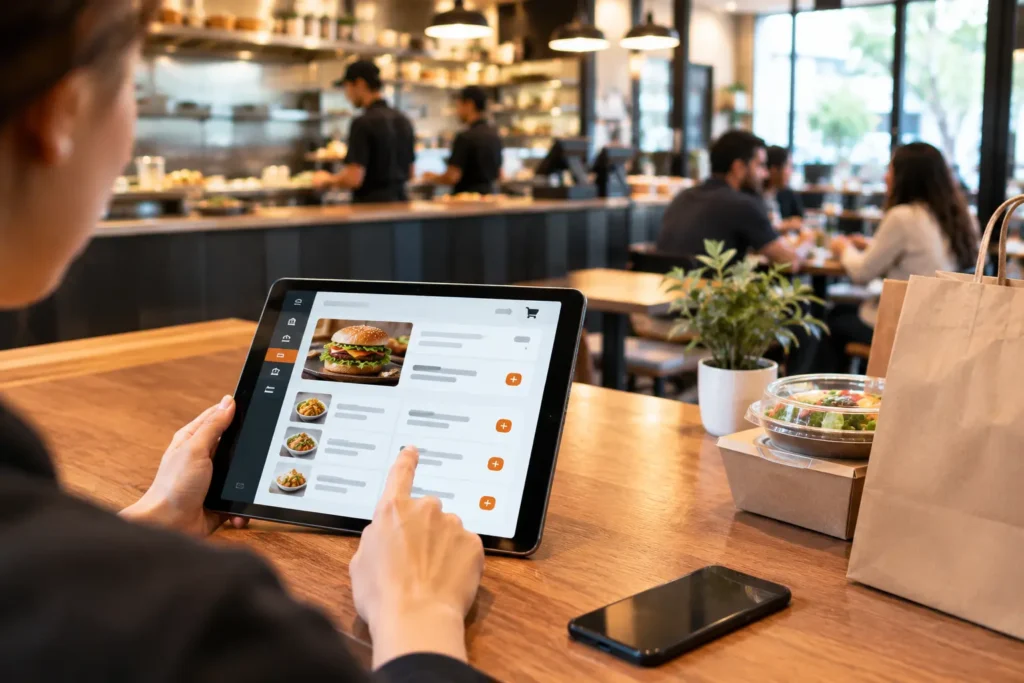
In simple terms, it replaces the order-taker with a digital ordering page. A customer picks items, adds notes such as “less spicy,” chooses delivery or pickup, and checks out. The order lands in the same queue as a counter order, the kitchen starts cooking, and the customer can follow progress until the food arrives. For a closer look at how this differs across devices, see our guide to mobile and web-based online ordering apps.
Why It Pays to Get More From Your Online Ordering System
Wider Reach Without a Bigger Dining Room
An online ordering system lets you sell to people who will never sit in your restaurant: office teams at lunch, families at home, and customers on the other side of the city. Your sales are no longer capped by the number of tables you have.
Better Order Accuracy
When customers type their own order and choose their own options, there is no mishearing on a noisy phone line. An automatic order confirmation repeats the details back, so mistakes are caught before the kitchen starts cooking.
Customer Insights You Can Act On
Every online order leaves a record: what was ordered, when, and how often. Over a few weeks, that order history shows your best sellers, your quiet hours, and your most loyal customers, which is the raw material for better menus and better offers.
More Convenience for Customers
Customers can browse at their own pace, save their address, reorder a favourite meal in two taps, and track their order instead of calling to ask where it is. Less friction usually means more frequent orders.
Direct Online Ordering vs Third-Party Delivery Apps
Before working on the tips below, it helps to be clear about what your own ordering channel is for. Most restaurants use both kinds of channel, and each does a different job:
- Third-party delivery apps help new customers discover you, but they take a commission on every order, control the customer relationship, and decide how your restaurant appears next to competitors.
- Direct online ordering through your own website, app, or WhatsApp keeps the full order value, the customer’s contact details, and the order history with you. It is where repeat customers should end up.
Commission is not a small line item. In 2020, Karachi restaurants publicly boycotted Foodpanda after it sought to raise commission from 18 percent to between 25 and 35 percent, according to Arab News. Rates have changed since then and vary by agreement, but the lesson holds: every order you move from a marketplace to your own channel improves your margin. A practical approach is to use marketplaces for discovery and use your own ordering software, with a small reason to order direct, for everyone who comes back.
10 Pro Tips to Get the Most From Your Restaurant’s Online Ordering Software
1. Choose Online Ordering Software That Fits How You Operate
Everything else depends on this choice. A platform that looks good in a demo can still slow you down if it does not match how your kitchen, counter, and riders actually work. When comparing options, check:
- Ease of use: staff should be able to accept, update, and close orders without training manuals, and customers should be able to order without help.
- POS integration: online orders should flow into your POS automatically, not be retyped.
- Menu and branding control: you should be able to change prices, photos, and item availability yourself, in minutes.
- Payment options: the system should support the payment methods your customers already use, including cash on delivery.
- Commission and pricing model: know whether you pay per order, a flat fee, or both.
- Branch support: if you run, or plan to run, more than one location, check how menus and orders are managed per branch.
- Customer data ownership: confirm that customer contact details and order history belong to you.
- Support during service hours: a problem at 9 pm on a Friday needs an answer at 9 pm on a Friday.
Our list of must-have features for a restaurant online ordering app goes deeper into the feature checklist.
2. Optimise Your Online Menu for Quick Decisions
Your online menu is your digital storefront. A long, cluttered menu makes customers scroll, hesitate, and leave. A focused one helps them decide quickly and often spend more. Good online menu management looks like this:
- Lead with your best sellers: put popular items and family deals at the top, in clear categories such as “Top Picks”, “Family Meals”, or “Deals”.
- Use real, appetising photos: people order with their eyes. A clear photo of the actual dish beats a stock image every time.
- Write short, specific descriptions: mention the key ingredients, portion size, and spice level, so customers know exactly what they will get.
- Make customisation easy: offer clear modifiers for spice level, extra cheese, sides, and drinks, and flag vegetarian or allergy-friendly options.
- Build combo deals: bundling a main, a side, and a drink is simpler for the customer and usually raises the order value.
- Keep item availability accurate: mark items as sold out the moment they run out, so customers never order something the kitchen cannot make.
- Suggest add-ons at checkout: a drink, dessert, or extra naan offered at the right moment is the easiest upsell you will ever make.
3. Make Ordering Fast on Mobile Phones
Most customers will see your ordering page on a phone, often on a patchy mobile connection. A mobile-friendly ordering system is not a bonus; it is the main experience. Focus on a few things:
- Fast loading: compress images and keep the page light. Every extra second gives a hungry customer time to open another app.
- Big, easy buttons: “Add to cart” and “Checkout” should be easy to tap with a thumb.
- Short checkout: ask only for what you need. Let returning customers save their address and reorder past meals.
- Test it yourself: place a real order on your own phone every few weeks, on mobile data, and fix whatever annoys you.
4. Offer the Payment Options Your Customers Actually Use
A customer who cannot pay the way they want will simply not finish the order. In Pakistan, that usually means supporting several methods side by side:
- Cash on delivery: still expected by many customers, so make it simple and record it clearly for rider cash collection.
- Debit and credit cards: through a secure payment gateway, with the card details handled by the gateway rather than stored by the restaurant.
- Mobile wallets: such as JazzCash and Easypaisa, which many customers prefer for small, frequent payments.
- Raast QR payments: the State Bank of Pakistan launched Raast person-to-merchant payments, including QR codes, to let customers pay merchants directly from their bank accounts (SBP press release). Check whether your payment provider supports it.
Whatever mix you choose, make sure online payment processing feeds into the same sales records as your counter sales, so your end-of-day figures add up without manual matching.
5. Connect Online Ordering to Your POS and Kitchen
If staff are reading orders off one screen and typing them into another, mistakes and delays are guaranteed. Restaurant POS integration removes that step. With your online ordering software connected to a cloud based POS system, you get:
- Automatic menu and price sync: change a price or add a dish once, and it updates on your website, app, and POS together.
- One order queue: online, phone, and counter orders are managed in one place, and every order reaches the kitchen display system in the same format.
- Real-time inventory updates: stock is reduced as orders come in, so you are less likely to sell items you no longer have.
We explain the setup in more detail in online ordering POS integration: how restaurants can connect every order.
6. Give Customers Clear Takeaway, Pickup, and Delivery Choices
Flexibility wins orders, but only if each option runs smoothly behind the scenes. Set up each fulfilment option properly:
- Takeaway and pickup ordering: show a realistic collection time based on current kitchen load, not a fixed promise.
- Scheduled orders: let customers order ahead for lunch, iftar, or a family dinner, so you can plan prep.
- Delivery zones and minimum order values: define where you deliver and the minimum order for each area, so deliveries stay profitable.
- Rider assignment: if you run your own riders, connect orders to a restaurant rider app so each order is assigned as soon as it is ready.
- Third-party delivery integration: if some orders still come from marketplaces, bring them into the same system so the kitchen works from one list.
7. Keep Customers Informed With Order Notifications and Tracking
“Where is my order?” is the most common call a delivery restaurant gets, and every one of those calls pulls a staff member away from service. Order notifications answer the question before it is asked:
- Instant order confirmation: sent the moment the order is placed, repeating the items, total, and expected time.
- Live order status: simple stages such as order placed, in the kitchen, out for delivery, and delivered.
- Delay alerts: if the kitchen is running late, an honest update keeps the customer calmer than silence.
Many customers in Pakistan already order and ask questions on WhatsApp, so sending updates there, or taking the order there in the first place through WhatsApp AI ordering, meets them where they already are.
8. Use Customer Data for Personalised Offers and Loyalty
One of the biggest advantages of direct online ordering is that the customer data is yours. Use it to bring people back:
- Recommendations based on past orders: if a customer orders the same burger every Friday, show it first and suggest a matching side.
- First-order discounts: a small welcome offer gives a new customer a reason to try your direct channel instead of a marketplace.
- Loyalty rewards: points, a free item after every few orders, or a birthday treat all encourage repeat orders.
- Family and group deals: bundle pricing for larger orders, which also suits office lunches and gatherings.
- Limited-time offers: short, clear deals such as a weekday lunch discount create a reason to order today.
- Win-back messages: a friendly offer to customers who have not ordered in a while often works better than chasing brand-new ones.
Keep promotions simple. A customer should understand the offer in a few seconds, and your staff should be able to apply it without confusion.
9. Track the Analytics That Actually Move Sales
Most online ordering platforms come with analytics, but the numbers only help if someone looks at them. Review these regularly:
- Conversion rate: the share of visitors who complete an order. A low rate often points to a slow page, a confusing menu, or a long checkout.
- Average order value (AOV): how much each order is worth on average. Combos and add-ons are the usual levers.
- Order preparation and delivery time: the time from order to handover. Long times show where the kitchen or delivery is struggling.
- Customer retention rate: how many customers order again. If it is low, loyalty offers and follow-up messages deserve attention.
- Peak hours and top items: when orders arrive and what sells, so you can plan staff and prep around real demand.
Pick one number to improve each month. Small, steady fixes beat a big redesign that nobody measures.
10. Market Your Online Ordering Channel Everywhere
Customers will not find your ordering page on their own. Tell them about it wherever they already see you:
- Social media: share new dishes and deals on Facebook and Instagram, with a direct link to order.
- Google Business Profile: add your ordering link so people searching for your restaurant can order in one step.
- Your website: put a clear “Order Online” button at the top of every page.
- In the restaurant and in every bag: table cards, receipts, and delivery packaging with a QR code to your ordering page.
- WhatsApp and SMS: short, occasional messages to customers who have agreed to hear from you.
If you want help with campaigns, our digital media marketing team works specifically with restaurants.
Managing Online Orders Across Multiple Branches
Online ordering gets more complicated once you have two or more branches. The common problems are menus that differ between locations, orders sent to the wrong branch, and sales that sit in separate reports. Multi-location ordering software should let you:
- Run a central menu with branch-level changes: keep one master menu with different prices or items where a branch needs them.
- Route each order to the right branch: based on the customer’s address or chosen pickup location.
- Set availability per branch: an item that sells out in one branch can stay available in another.
- See all branches in one dashboard: compare sales, order volume, and delivery times side by side.
Common Online Ordering Mistakes to Avoid
- Copying the dine-in menu online without trimming or adding photos.
- Leaving sold-out items listed during the rush.
- Promising delivery times the kitchen cannot meet at peak hours.
- Running a separate tablet for every channel instead of one order queue.
- Never checking the ordering page on a phone after launch.
How CherryBerry RMS Supports Online Ordering
CherryBerry RMS offers a branded ordering platform for web and mobile that routes website, app, WhatsApp, and phone orders into one dashboard. According to its online ordering and order management software page, orders sync to the POS and kitchen display system without manual re-entry, customers see live status updates from order placed to delivered, and multi-branch restaurants can manage menus, pricing, and item availability per location. The platform runs on a zero-commission model, so the restaurant keeps its customer data and margins, and support is available 24/7.
If you are still deciding between building your own channel and staying on marketplaces, our guide to online ordering apps for restaurants in Lahore and across Pakistan covers the bigger picture, and how online ordering fits into a restaurant management system explains where it sits alongside your other tools.
Frequently Asked Questions
What is restaurant online ordering software?
It is a system that lets customers order and pay through a restaurant’s own website, app, or messaging channel, and sends each order directly to the POS and kitchen. It also manages order confirmations, status updates, and sales records.
How does online ordering software work for restaurants?
The customer browses the online menu, adds items, chooses delivery or pickup, and pays. The order goes straight to the POS and kitchen display; the kitchen prepares it, and the customer receives status updates until it is delivered or collected.
What features should restaurant online ordering software have?
Look for easy menu management, POS integration, multiple payment options including cash on delivery, order notifications and tracking, pickup and delivery settings, customer data and analytics, and support for multiple branches if you need it.
Is direct online ordering better than third-party delivery apps?
They serve different purposes. Third-party apps help new customers find you but charge commission and keep the customer relationship. Direct online ordering keeps the full order value and customer data with you, so it works best for repeat customers.
How do I integrate online ordering with my restaurant POS?
Choose ordering software that connects directly to your POS, or use one platform that includes both. Then match your menu items, prices, and modifiers in both systems so orders arrive in the POS and kitchen without retyping.
How can I reduce online ordering errors in my restaurant?
Keep the menu clear with simple modifiers, mark sold-out items immediately, send automatic order confirmations, and connect online orders to your POS and kitchen display so nobody has to re-enter them by hand.
Conclusion
Getting more from your restaurant’s online ordering software is rarely about adding features. It is about a clear menu, a quick mobile checkout, the right payment options, a direct link to your POS and kitchen, and a steady habit of checking the numbers and bringing customers back. Pick two or three tips from this list, apply them this month, and measure the difference before moving on to the next.