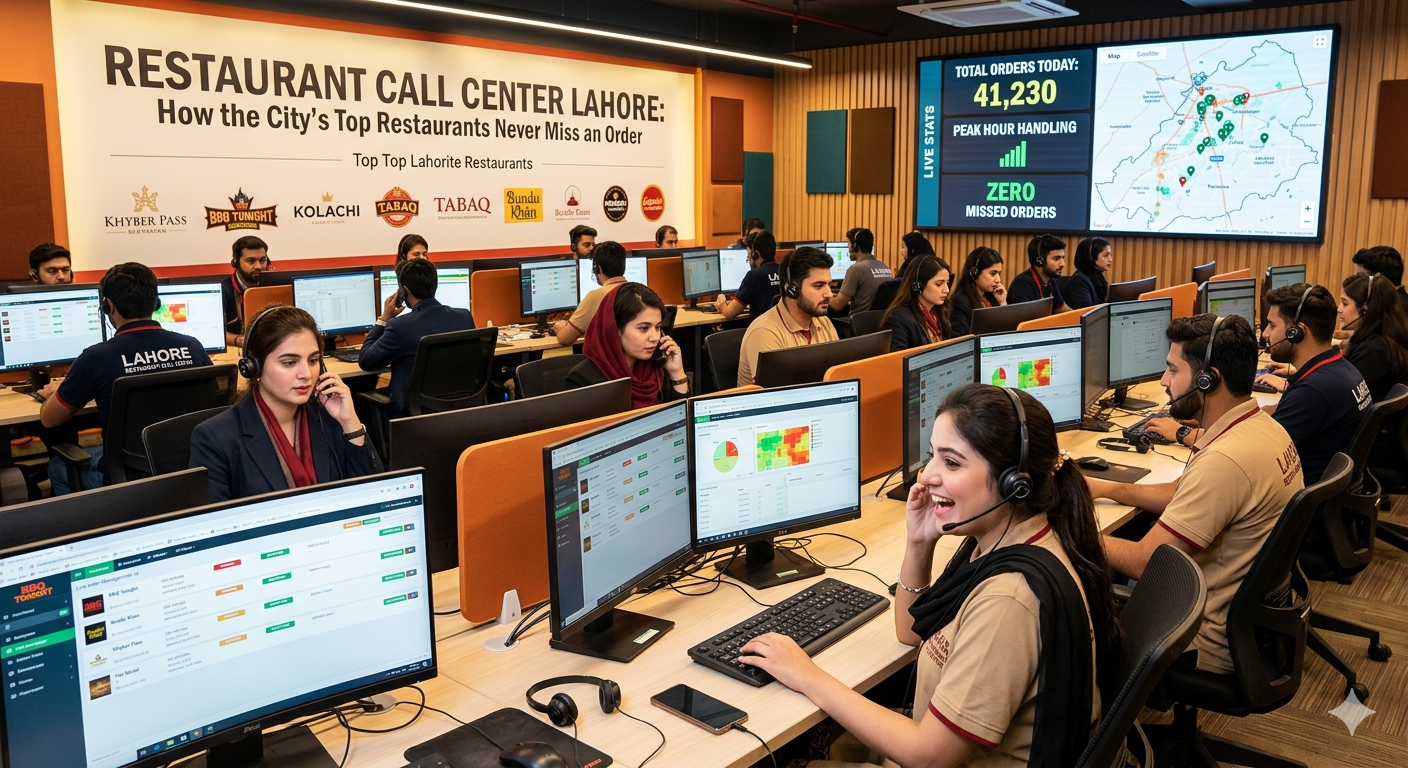
Restaurant Call Center Lahore: How the City’s Top Restaurants Never Miss an Order
Lahore’s restaurant industry is one of the most competitive food markets in South Asia. From the legendary food streets of Gawalmandi and MM Alam Road to the upscale dining corridors of DHA Phase 5 and Gulberg, the city hosts thousands of food businesses fighting for the same hungry customers — every single day.
And yet, most of them are silently losing revenue through one overlooked gap: the phone.
A recent operational audit of mid-sized Lahore restaurants found that up to 38% of inbound calls during peak dinner hours go unanswered. At an average order value of PKR 1,400 per call, a busy Lahori restaurant missing just 20 calls per day is walking away from over PKR 840,000 per month in recoverable revenue.
This is exactly the problem a Restaurant Call Center in Lahore is designed to solve — permanently.
Why Lahore Restaurants Face a Unique Call Management Challenge
Lahore is not just Pakistan’s second-largest city — it is the country’s undisputed food capital. The city’s food culture runs deep, and with it comes a level of customer expectation that is far higher than most markets.
Lahori diners are vocal, brand-loyal, and phone-first.
Unlike Karachi’s digitally-driven ordering culture, a significant portion of Lahore’s restaurant orders — particularly in areas like Johar Town, Bahria Town, and Model Town — still come through direct phone calls. Customers in these localities trust a voice on the phone over an app confirmation, especially for large family orders, customized dishes, and catering inquiries.
According to Pakistan Telecommunication Authority (PTA) data, voice call usage in Punjab — with Lahore as its urban center — remains among the highest in the country across all demographic segments. For restaurant owners, this means the phone channel is not declining — it is simply being mismanaged.
Three factors make Lahore’s call management challenge distinct:
- Volume spikes are extreme. Lahore’s dining culture peaks hard on Fridays, Saturdays, and during Ramadan. Without a dedicated system, phone lines become completely overwhelmed during these windows.
- Competition is hyperlocal. In areas like MM Alam Road, a customer who can’t reach one restaurant will call the next one within seconds. Brand loyalty has limits when hunger is immediate.
- Delivery geography is complex. Lahore’s sprawling layout — from Cantt to Raiwind Road — means delivery zone management, address confirmation, and routing need to be handled precisely on every call.
What a Restaurant Call Center in Lahore Actually Looks Like
A restaurant call center is a dedicated communication operation — staffed by trained agents or powered by AI systems — that handles all inbound and outbound calls for your restaurant. It is separate from your floor team, your cashier, and your kitchen staff.
For a comprehensive overview of call center models, technology requirements, and national industry context, refer to our Restaurant Call Center Pakistan: The Complete Guide for 2026.
In a Lahore context, this typically takes one of three forms:
1. In-House Dedicated Call Agent (Best for Single-Branch Lahore Restaurants)
One trained staff member, stationed at a separate workstation away from the floor, handles all inbound calls using a headset, a CRM, and a live view of your menu and inventory. Orders are entered directly into your Restaurant Management System (RMS) and routed to kitchen screens instantly.
Ideal for: Restaurants in Gulberg, Garden Town, or Liberty Market receiving 40–80 calls per day.
Monthly investment: PKR 55,000–75,000 (agent salary + CRM subscription)
2. Centralized Call Center for Multi-Branch Chains
This is where Lahore’s growing restaurant chains are seeing the biggest ROI.
A restaurant with branches in DHA, Johar Town, and Bahria Town can operate a single centralized call center that handles orders for all locations simultaneously. The agent identifies the caller’s area, routes the order to the correct branch, and confirms estimated delivery time — all within 90 seconds.
Real-world example: A well-known Lahori BBQ chain operating five branches across the city — including outlets near Packages Mall and Emporium Mall — implemented a centralized call team of four agents in 2024. Within three months, their call answer rate rose from 58% to 96%, average order value increased by PKR 210 due to structured upselling, and their Google Reviews rating climbed from 3.9 to 4.5 stars across all branches.
The operational math was simple: the call center cost PKR 280,000 per month to run. It recovered over PKR 1.1 million in previously missed order revenue in its first full month.
3. AI-Powered Voice Agents (The 2026 Growth Model)
This is the fastest-growing solution among Lahore’s tech-forward restaurant operators.
AI voice agents — trained on your menu, your pricing, your delivery zones across Lahore’s neighborhoods, and even common Urdu and Punjabi phrases — can now handle standard order-taking calls without any human involvement. The order flows directly into your Cloud-Based POS System for kitchen processing.
For a Lahore restaurant receiving 150+ calls per day, this model reduces labor costs by 60–70% while maintaining near-perfect call answer rates around the clock.
Hybrid approach (recommended): AI handles routine orders. Complex calls — complaints, large catering orders, delivery disputes — escalate instantly to a live human agent. This is now the preferred model for Lahore’s mid-to-large restaurant operations.
The Lahore Peak Hour Problem — And How to Solve It
Every experienced Lahore restaurant owner knows the nightmare: Friday 7:30 PM.
The phone doesn’t stop ringing. The floor is packed. The kitchen is at full capacity. And whoever happens to be standing nearest to the phone becomes your “call center” — distracted, rushed, and taking orders on a notepad that may or may not make it to the kitchen accurately.
This scenario costs Lahore restaurants money in three specific ways:
- Missed calls — customers who hang up after 4–5 rings and order elsewhere
- Order errors — wrong items, wrong addresses, wrong quantities entered under pressure
- Upselling failure — a stressed floor staff member taking a call never suggests the add-on drink or the dessert; a trained call agent almost always does
A properly structured restaurant call center eliminates all three simultaneously.
The solution for Lahore’s peak hours comes down to two things:
- Dedicated staffing — agents whose only job during Friday and Saturday evening windows is answering calls, with zero floor responsibilities
- Technology integration — orders entered directly into your kitchen system, with no manual handoff, no relay errors, and real-time delivery tracking through your Rider App
Lahore-Specific Features Your Restaurant Call Center Must Have
Not every call center solution is built for Lahore’s market. When evaluating or building your system, these features are non-negotiable for this city:
Urdu and Punjabi language capability. Your call agents must communicate naturally in both. A caller from Samanabad and a caller from DHA Phase 6 may speak very differently. Agents who can shift registers confidently build customer trust instantly.
Lahore delivery zone mapping. Your system must have clear, pre-mapped delivery zones for every major Lahore neighborhood — including Wapda Town, Faisal Town, Cavalry Ground, Gulshan Ravi, and Allama Iqbal Town — so agents can confirm delivery feasibility and estimated times accurately on every call.
Ramadan and peak event protocols. Lahore’s call volume during Ramadan Iftar windows and Eid periods can be 3–4 times normal. Your call center needs a documented surge protocol — additional agents, pre-written scripts for fast order-taking, and kitchen communication channels that don’t create bottlenecks.
WhatsApp Business integration. Increasingly, Lahore customers — particularly those under 35 — send orders via WhatsApp rather than calling. The best restaurant call center setups in Lahore manage both channels from one interface, so no order falls through the cracks regardless of how the customer reaches out.
CRM with repeat customer recognition. When a customer from Johar Town who orders every Thursday calls, your agent should greet them by name and ask if they’d like “the usual.” This level of personalization drives loyalty far more effectively than any discount campaign.
Setting Up a Restaurant Call Center in Lahore: A Practical Starting Point
If you’re a Lahore restaurant owner ready to build this capability, here is where to begin:
- Measure first. Install a call tracking tool — or simply review your phone logs for the past two weeks. How many calls did you receive? When did peaks occur? How many went unanswered? These numbers tell you exactly what model you need.
- Start lean. Most Lahore single-branch restaurants need one dedicated agent and a basic CRM to see immediate improvement. You don’t need an enterprise call center on Day 1.
- Write your scripts. Document the exact language your agents use for: standard order-taking, address confirmation for every major Lahore neighborhood, out-of-stock apologies with alternatives, complaint handling, and upsell offers. Consistency comes from scripts, not improvisation.
- Integrate with your kitchen. Your call center is only as valuable as its connection to your Kitchen Management System. Orders must appear on kitchen screens the moment they’re taken — no paper, no relay, no errors.
- Track weekly. Monitor call answer rate (target: 95%+), order accuracy rate (target: 98%+), average handle time, and upsell conversion rate. Review call recordings monthly. Improve continuously.
- For a full step-by-step national framework, the Restaurant Call Center Pakistan Complete Guide covers every stage of setup in detail.
Direct Orders vs. Third-Party Platforms: Why Lahore Restaurants Are Shifting
Foodpanda, Careem Food, and similar platforms charge 18–30% commission per order. For a Lahore restaurant processing PKR 2,000,000 in monthly delivery revenue through these platforms, that’s PKR 360,000–600,000 per month in commission paid to a third party.
A strong restaurant call center changes this equation.
Every customer who calls your restaurant directly — and receives a professional, friendly, accurate experience — is a customer who is less likely to open an app next time. Trained agents can reinforce this behavior: “Call us directly next time and we’ll guarantee your order is prioritized.”
Lahore restaurants that have built direct phone ordering capacity report that every PKR 1 invested in call center infrastructure saves PKR 4–6 in avoided platform commissions over 12 months.
According to the National Restaurant Association’s global benchmarks, restaurants that build strong direct ordering channels consistently achieve 8–12% higher net margins compared to those heavily dependent on third-party delivery platforms — a finding that maps directly onto Lahore’s market dynamics.
The Bottom Line for Lahore Restaurant Owners
Lahore’s food market rewards operators who build systems, not just kitchens. Your food quality brings customers in. Your call center keeps them coming back — and keeps their money from going to your competitor down the street.
Whether you’re running a small café in Gulberg, a multi-branch biryani chain across Johar Town, DHA, and Bahria Town, or a high-volume delivery kitchen in Faisal Town — a structured restaurant call center is one of the highest-return investments available to you in 2026.
The phone is still ringing. The only question is whether your restaurant is the one answering it professionally.
Ready to build your restaurant call center? Explore CherryBerry RMS’s Call Center Services — built specifically for Pakistani restaurant operations.
Frequently Asked Questions — Restaurant Call Center Lahore
Q1: How much does a restaurant call center cost in Lahore?
For a single in-house agent with a CRM and headset, budget PKR 55,000–80,000 per month, including salary and software. AI voice agent solutions start from PKR 15,000–35,000 per month, depending on call volume. Multi-agent setups for larger Lahore chains typically run PKR 150,000–350,000 per month. Most restaurants recover this investment within 4–6 weeks through recovered missed-order revenue alone.
Q2: Which areas of Lahore benefit most from a restaurant call center?
High-volume delivery neighborhoods — DHA, Bahria Town, Johar Town, Gulberg, and Model Town — benefit most, as customer expectations in these areas are highest and competition is most intense. However, restaurants in areas like Samanabad, Allama Iqbal Town, and Cantt also see strong results because phone ordering remains the primary channel in these localities.
Q3: Can a small Lahore restaurant afford a call center setup?
Yes. A single dedicated call agent — even a part-time one covering peak hours (12 PM–3 PM and 6 PM–10 PM) — can deliver significant ROI for a restaurant receiving just 30–40 daily calls. The key is not size; it’s structure. A trained agent with a script and a basic CRM outperforms an untrained floor staff member answering calls between tasks, regardless of the restaurant’s scale.
Q4: Should Lahore restaurants use AI call agents or human agents?
Both, ideally. A hybrid model — AI handles routine standard orders; human agents handle complaints, complex customizations, and large catering inquiries — is the recommended approach for 2026. Pure AI works well for high-volume, standardized menus. Pure human works better for restaurants with complex, customizable offerings. Most growing Lahore restaurant chains are moving toward hybrid setups that balance cost efficiency with service quality.
Q5: How does a restaurant call center in Lahore handle Ramadan peak hours?
Professional call centers implement a documented surge protocol: additional agents deployed specifically for Iftar window (typically 5:30PM–8:00PM), pre-written fast-order scripts, simplified order confirmation language, and direct priority queuing to kitchen systems. Restaurants that plan this 4–6 weeks before Ramadan consistently report 30–40% fewer missed calls and significantly higher customer satisfaction during the month compared to those who manage ad hoc.
Q6: How can a Lahore restaurant call center reduce Foodpanda commission dependency?
By building a loyal direct-call customer base. Trained agents actively encourage repeat callers to save your direct number. You can offer small incentives for direct calls — free delivery, a complimentary item, or priority queue during peak hours. Over 6–12 months, restaurants that invest in direct phone channels consistently shift 20–35% of their delivery orders away from commission-based platforms, materially improving net margins.
