POS Inventory Management System for Restaurants: Track Stock, Reduce Waste & Control Costs
If you’ve ever run out of chicken during mid-dinner rush or opened the walk-in to find three cases of sauce that expired last week, you already know the real problem. Most restaurants don’t actually have a “stock” problem: they have a visibility problem. Nobody knows what’s actually on the shelf until it’s too late.
That’s exactly the gap POS inventory management is built to close. Instead of a clipboard, a gut feeling, or a manager doing a “quick count” between rushes, a connected POS inventory system tracks every ingredient, every sale, and every reorder automatically, right from the same screen your cashier already uses to ring up orders.
In this blog, we’ll cover exactly how it works, what it actually costs restaurants when it’s missing, which features genuinely matter, and how to pick a system that fits how your kitchen really runs, not just what a sales page promises.
Quick note on terminology before we dive in: you’ll see this called a lot of different things depending on where you look: a Point of Sale (POS) inventory management system, POS inventory management software, a POS system with inventory management, or simply inventory management POS. They’re all pointing at the same idea, so don’t get hung up on the exact wording when you’re comparing providers.
What Is POS Inventory Management?
In simple terms, POS inventory management means your point-of-sale system and your stock records talk to each other automatically. When a dish sells, the ingredients behind it get deducted from stock; nobody has to manually update a spreadsheet after close.
This is different from old-school stock tracking. Traditional inventory counts happen once a week, on paper, after the damage is already done. A modern, inventory-connected point-of-sale setup runs real-time inventory tracking for restaurants continuously the moment an order is rung up, cancelled, or comped.
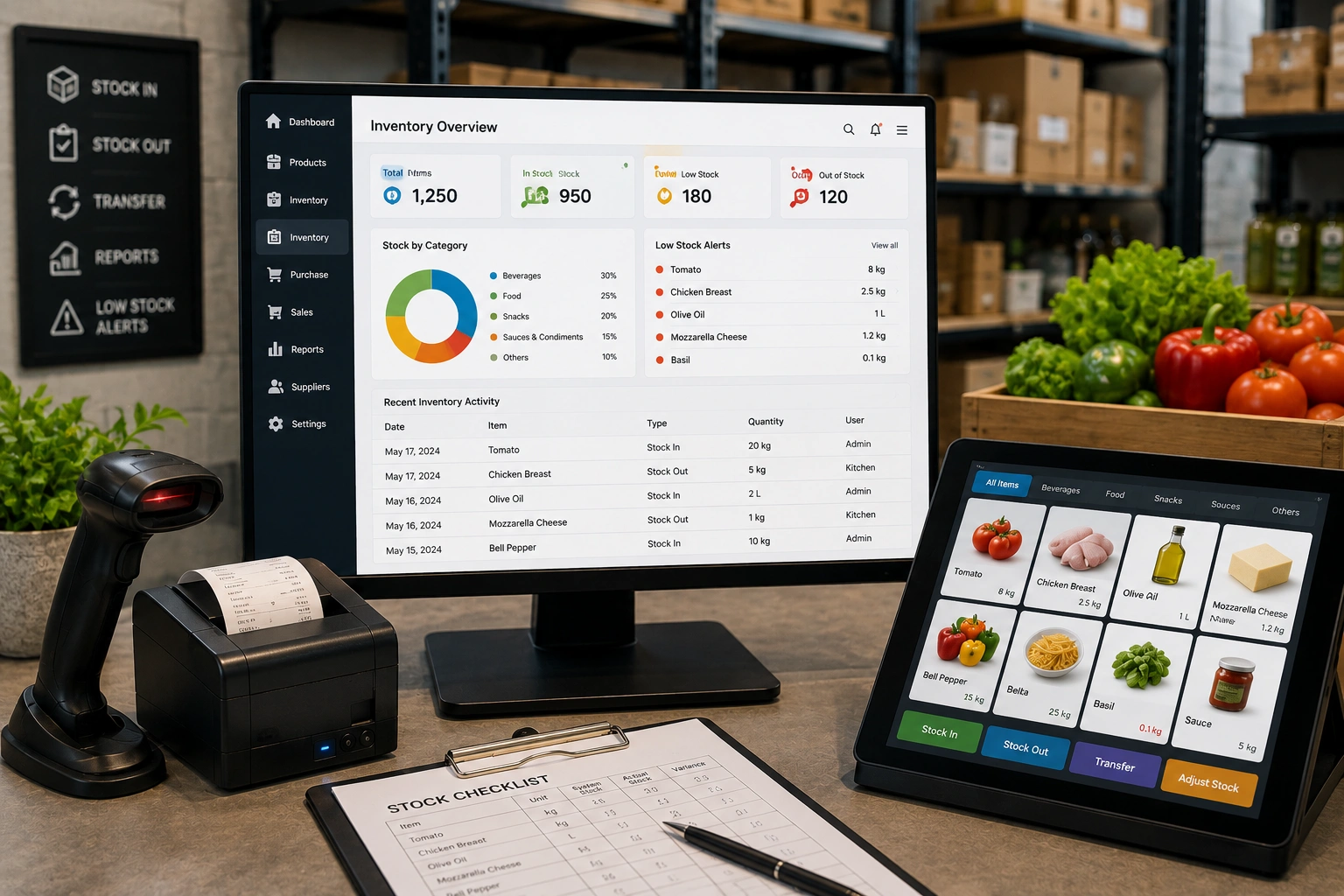
Here’s what actually gets tracked automatically once it’s set up:
- Stock levels for every raw ingredient and finished item
- Ingredient-level tracking tied to each recipe on your menu
- Low-stock alerts before you actually run out mid-shift
- Purchase orders sent automatically once stock hits a set threshold
- Stock adjustments for waste, spoilage, staff meals, or comped items
What Is the Difference Between POS and Standalone Inventory Software?
This is one of the most common questions owners ask once they start comparing options, so it’s worth answering directly. Standalone inventory software runs completely separately from your billing. Someone has to manually enter every sale, every waste log, and every purchase, then reconcile it against what the register says at the end of the night.
A POS and inventory management system, by contrast, is built into the same platform you already use to take orders, like a Cloud-Based Restaurant POS System. There’s no second login, no re-typing, and no gap between what actually sold and what the stock count shows.
- Standalone inventory software: manual entry, delayed updates, separate login, reconciled after the fact
- POS-integrated inventory: automatic deduction, real-time sync, one dashboard, no double entry
For restaurants already relying on a Restaurant Back Office system for accounting, plugging inventory directly into the POS removes one more spreadsheet from the pile instead of adding a third tool to reconcile.
Why This Actually Matters (The Money Question)
Food waste isn’t a minor line item: it’s a real drain on margins. In the U.S. alone, restaurants generate close to 11.4 million tons of wasted food every year, costing the industry roughly $25 billion annually. A large chunk of that comes down to one thing: nobody knew exactly what was in stock, so ordering and prep were based on guesswork instead of data.
Food cost is already tight before waste even enters the picture. Food costs eat up about 33 cents of every sales dollar, while average restaurant profit margins sit at a thin 3–5%. When margins are that slim, an inventory blind spot isn’t a small inconvenience: it’s the difference between closing the month in profit or in the red.
This is exactly the gap POS inventory management is designed to close. It turns “we think we’re low on chicken” into “we have exactly 4.2 kg left, and a reorder just went out.”
There’s also a labour-cost angle people tend to overlook. A manager doing a manual stock count is a manager who isn’t training staff, checking on the dining room, or reviewing this week’s numbers. Every hour spent counting inventory by hand is an hour that automated real-time inventory tracking could have handled in the background, for free, without a clipboard in sight.
Restaurant Inventory vs. Retail Inventory: Why the Difference Matters
It’s worth pausing on this, because a lot of confusion starts here. Retail-focused platforms like Square and Lightspeed Retail are excellent at tracking finished, sellable products: a T-shirt, a candle, a six-pack. But a restaurant doesn’t sell ingredients directly; it sells a combination of them, cooked, plated, and often modified on request.
That’s why restaurant-focused tools build in recipe-based tracking specifically. This is because a burger sold isn’t one inventory deduction; it’s five or six happening at once, in different units, at different costs. If you’re evaluating any restaurant POS platform, this is the single biggest thing to check before signing up: does it actually understand recipes, or does it just count finished items like a retail shelf?
How a POS Inventory System Actually Works
Whether you call it POS systems for inventory management, a POS inventory management system, or just a POS system for restaurant inventory tracking, here’s what’s actually happening behind the scenes, step by step, once everything is connected properly:
Step 1: Every Menu Item Gets Mapped to Its Ingredients
Before anything can be tracked automatically, someone maps each recipe to the ingredients it uses: a burger to its bun, patty, and sauce; a cocktail to its spirits and garnish. This recipe-based tracking setup is the foundation everything else builds on.
Step 2: Stock Deducts Automatically at the Point of Sale
Once a dish is billed, the system instantly reduces the exact quantity of each ingredient used. Cancel an order, and the stock deduction reverses. Comp a meal, and it still counts as used stock, not a free pass.
Step 3: Low Stock Triggers an Alert, Not a Surprise
Once you’ve set your reorder points, the system flags anything approaching a shortage through POS inventory tracking, long before a server has to tell a table, “We’re out of that today.
Step 4: Purchase Orders Go Out Without a Phone Call
Many systems support automatic reordering, generating and sending a purchase order to your usual supplier once stock crosses a set threshold. Paired with vendor management tools, this cuts out a surprising amount of manual admin work.
Step 5: Waste and Shrinkage Get Logged, Not Guessed
Spoilage, breakage, and theft all fall under shrinkage. A good system lets staff log it with a reason code, so it shows up in reports instead of quietly disappearing into “unexplained variance.
Step 6: Reports Tell You What’s Actually Happening
At the end of the week, you’re not counting shelves: you’re reading a report. Inventory valuation and cost of goods sold (COGS) figures show you exactly where your money went, and inventory forecasting helps you order smarter next time instead of repeating the same mistake.
Core Features Every POS Inventory System Should Have
Not every system on the market covers the basics well. If you’re comparing options, here’s what actually moves the needle:
- Real-time inventory tracking: updates should happen the moment a sale is rung up, not in a nightly batch job you only see the next morning.
- Ingredient-level / recipe-based tracking for restaurants, not just SKU-level counts borrowed from a retail template.
- Low-stock alerts and automatic reordering so nobody has to babysit stock levels manually between shifts.
- Barcode scanning and SKU management for fast, accurate counts during deliveries and physical audits.
- Multi-location inventory support if you run more than one outlet, including the ability to transfer stock between branches.
- Vendor and purchase order management built in, not bolted on as an afterthought or a separate spreadsheet.
- Inventory valuation and food cost percentage reporting you can actually act on, broken down by menu item, not just overall spend.
- Native integration with your Kitchen Display System (KDS) and CRM, so front-of-house, kitchen, and loyalty data all stay in sync instead of living in separate silos.
One thing worth flagging: a long feature list on a pricing page doesn’t always mean a smooth day-to-day experience. Whether the provider markets itself as inventory management software with POS or a POS and inventory management system, it’s worth asking for a live demo. Actually watching someone ring up a sale, cancel it, and check whether the stock count updates immediately, this ten-minute test tells you more than any spec sheet.
Benefits of Using a POS Inventory Management System
Put all those features together, and the day-to-day payoff looks like this:
- Improved efficiency: automates the counting and paperwork that used to eat up a manager’s evening, freeing that time for staff and customers instead.
- Accurate, real-time tracking: real-time inventory tracking means stock numbers reflect what’s actually on the shelf, not what a count from three days ago says.
- Cost savings: fewer over-orders, less shrinkage, and less spoiled stock protect margins that are already thin industry-wide.
- Streamlined purchasing: automatic reordering and vendor management cut out the back-and-forth phone calls and missed reorder windows.
- Data-driven decisions: inventory valuation and food cost percentage reports show exactly which menu items are actually profitable, not just popular.
- Scalability: multi-location inventory support means the system grows with you, and pairs naturally with a connected kitchen management system as order volume increases.
These benefits compound with each other. Restaurants that also sync online orders directly into the POS (see our guide on Online Ordering POS Integration) get the same real-time stock accuracy whether an order comes from a dine-in table or a delivery app, instead of managing two separate stock counts.
POS Inventory Management and Food Waste: How the Two Connect
Here’s the mechanism: when ordering is based on real usage data instead of a gut feeling, you stop over-buying perishables “just in case.” Recipe-based deduction means portion sizes stay honest, and inventory audits catch shrinkage trends, like a specific shift consistently running high variance, before they become a habit.
None of this requires a culture overhaul. It’s mostly about removing the guesswork that causes over-ordering and under-using stock before it spoils in the first place.
Common Mistakes Restaurants Make Without a Proper POS Inventory System
- Counting stock manually on a clipboard or spreadsheet that’s already out of date by the next shift
- Never mapping recipes to ingredients, so the POS has no idea what a sold dish actually consumed
- Ignoring low-stock alerts because staff have learned to tune out notifications
- Handling every purchase order by phone or email instead of using built-in vendor management
- Never looking at cost of goods sold (COGS) reports to see which menu items are quietly losing money
- Skipping regular inventory audits, so shrinkage and theft go unnoticed for months
Individually, none of these feels like a crisis. Together, over a few months, they quietly eat into margins that were already thin to begin with, which is exactly why so many owners only notice the problem once they sit down and actually run the numbers.
How to Choose the Right POS Inventory Management for Your Restaurant
A few honest questions before you commit to any provider, whether you’re comparing the best pos and inventory system options on a shortlist or reading through best pos inventory systems roundups online:
- Does it handle recipes, not just products? Retail-first POS tools often track finished items only, missing ingredient-level detail restaurants actually need.
- Is barcode scanning and vendor management included, or an expensive add-on? Check pricing tiers carefully.
- Can it scale across locations? Confirm multi-location inventory support before you expand, not after.
- Does it plug into your existing KDS and payment setup? A rip-and-replace overhaul is rarely worth it if your current hardware still works.
- Will your staff actually use it? The best system on paper is worthless if the interface is too clunky for a busy Friday night.
Conclusion: Stop Running Your Kitchen on Guesswork
Every missed alert, every over-order, every unexplained shortage at 7 pm on a Saturday: that’s the real cost of running a restaurant without proper POS inventory management. None of it is inevitable. It’s a visibility problem, and visibility is exactly what a connected POS inventory system is built to give you.
If you’re ready to move from clipboards and guesswork to real-time stock tracking, automated reordering, and food-cost reports you can actually trust, that’s exactly what CherryBerry RMS is built for: an all-in-one POS sales and inventory system that brings POS, inventory, and kitchen operations together in one place so you’re not stitching together five different tools just to know what’s left in the walk-in.
FAQs About Restaurant Inventory Software
What is POS inventory management?
POS inventory management is the practice of connecting your point-of-sale system directly to your stock records, so ingredients and products are tracked and deducted automatically as sales happen, instead of being counted manually after the fact.
How does inventory management work in a POS system?
Every menu item is mapped to its ingredients. When it sells, the system deducts those quantities from stock instantly. This is the core of how inventory management works in a POS system, and it also generates alerts or purchase orders once stock crosses a set threshold.
Can a POS system track ingredients, not just finished products?
Yes, but only if it’s built with recipe-based tracking. Retail-first POS system for inventory tools often stop at finished-product SKUs, so restaurants should specifically confirm ingredient-level tracking is included before choosing a system.
What’s the difference between a POS system and a standalone inventory management system?
A standalone system usually requires manual data entry and runs separately from your billing. Inventory management with a POS updates stock automatically the moment a sale happens, with no double entry required.
How much does a POS inventory system cost?
Pricing varies widely by provider and business size: some POS platforms include basic inventory features at low cost, while advanced tools like purchase ordering, multi-location sync, and detailed cost of goods sold (COGS) reporting are often paid add-ons. It’s worth comparing what’s included in the base plan versus what’s locked behind an upgrade before assuming inventory features are out of budget.
Can POS inventory management reduce food waste?
Yes. By replacing guesswork with real usage data, restaurants order closer to what they actually need, catch shrinkage earlier through regular inventory audits, and reduce the over-purchasing that leads to spoiled stock.
Does POS inventory management work for multi-location restaurants?
Most modern systems support multi-location inventory, letting owners view stock, transfer items between branches, and pull consolidated reports from a single dashboard rather than checking each location separately.
Do I need barcode scanners for POS inventory tracking?
Not strictly, but barcode scanning speeds up stock counts significantly and reduces manual entry errors. Most restaurants find it pays for itself quickly once volume picks up.
How do I switch from manual inventory to a POS-based system without disrupting service?
Most restaurants run a short overlap period: keep the manual count as a backup for one or two weeks while the recipe-based tracking setup is being configured item by item. Once the numbers between the two match consistently, it’s safe to drop the manual process entirely.
