

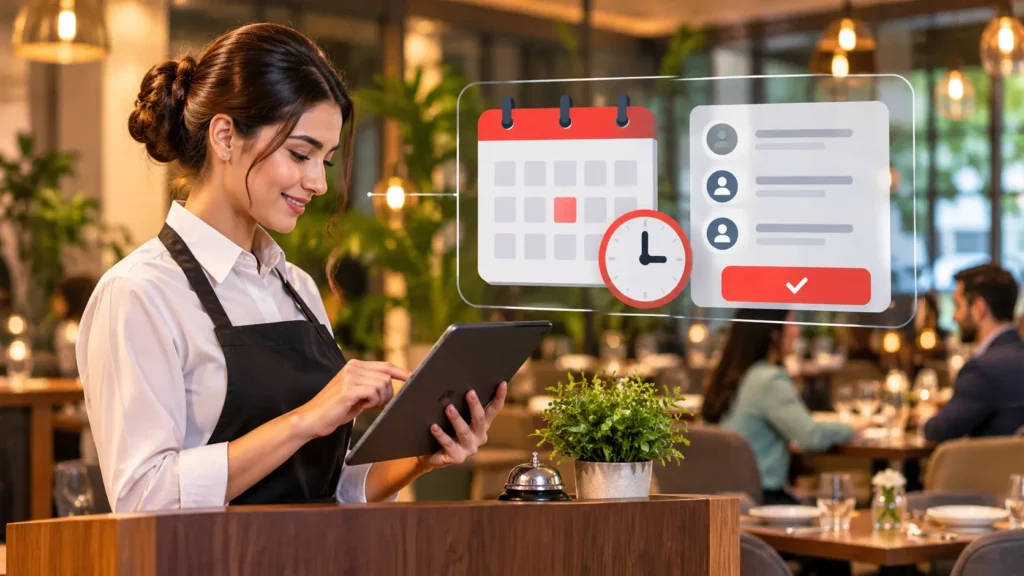
Online reservation software lets guests book a table from your website, app, or Google listing at any time. It confirms the booking automatically. Hence, restaurants get fewer no-shows, no double bookings, less phone time, and a guest record they own.
This guide explains how the software works and the twelve benefits that change daily service. It also covers what is different for restaurants in Pakistan. You will also learn how to set a no-show policy that guests will actually accept.
The Problem With How Most Restaurants Still Book Tables
Before getting into the benefits, it is worth being honest about what manual booking actually costs. Phone reservations depend entirely on staff availability. If your host is busy, the phone rings out. If a booking gets written down incorrectly, a guest arrives with a problem. You have to solve it on the spot. If two staff members both take a booking for the same table on a busy Saturday, you have a situation. No amount of charm can fully smooth it over.
Beyond the errors, there is the time cost. A host who spends the evening answering the phone is not working the room. The diary only tells you what tonight looks like, never what next Friday looks like. That time is what your most experienced front-of-house people should spend building guest relationships. It should also go on delivering the dining experience your restaurant promises.
Renting a booking channel from a third-party platform has its own problems. In a June 2025 survey by the US National Restaurant Association, more than two-thirds of diners said unauthorised third-party reservation sales harm both restaurants and guests. Almost 15% said they had been charged for a booking themselves. The safer route is a reservation channel the restaurant owns, with no fee between the guest and the table.
What Is Online Reservation Software?
Online reservation software is a cloud-based system that takes table bookings from your website, app, and Google listing. It confirms them automatically. It shows your team every booking, table, and guest note in real time.
Most systems also send reminders, store guest history, and sync with the POS. A booking becomes part of the restaurant’s operating data rather than a note at the host stand. It manages seats and time, not menus and delivery, so it is not an ordering app.
How a restaurant reservation system works, step by step
- The guest picks a date, time, and party size on your booking page. It is reached through a website widget, your app, the link on your Google Business Profile, or a link you drop into a WhatsApp chat.
- The system checks live table availability against your floor plan and capacity rules. Two guests cannot hold the same table at the same time.
- A reservation confirmation goes out instantly by SMS, WhatsApp or email. The booking appears on the restaurant’s calendar at the same moment.
- Automated booking notifications remind the guest before the visit. The guest can confirm, change, or cancel from the message instead of calling.
- At service, the host sees arrivals, table status, and any notes, and seats walk-in guests into the gaps between bookings.
- After the visit, the guest’s history (visits, party size, preferences) is saved for next time. Reports show covers, peak hours, cancellations and no-shows.
12 Benefits of Online Reservation Software for Restaurants
Each benefit below starts with the practical result, then explains how the software produces it.
1. Bookings arrive around the clock
The system takes reservations at 11 pm on a Sunday and 7 am on a Monday, when nobody is at the host stand. Guests book when it suits them. The restaurant never misses a booking because the phone was busy. The host arrives to a calendar that is already filling up.
2. Double bookings stop
Centralising every reservation in one live record is what removes double bookings and overbookings. The moment a table is held, it is blocked on the website widget, the app, and any other booking channel. The host stand sees the same picture. Table allocation becomes a rule the system enforces rather than a memory test for whoever answered the phone.
3. Staff spend less time on the phone
Online table booking takes the routine calls away from your team. Guests who would have phoned to ask “do you have a table for four at eight?” answer that question themselves on the booking page. The phone keeps ringing for guests who prefer it. The host is no longer tied to it during the rush.
4. Fewer no-shows, because guests can act on the reminder
Reminders are one of the most practical ways to cut no-shows, and the reason is simple. In a 2008 Cornell University survey of 1,230 frequent diners, respondents often said they found it hard to reach a restaurant to change a reservation. When the reminder carries a cancel or change link, the guest who cannot make it tells you. The table goes back on sale instead of sitting empty.
5. A calmer host stand and better table management
Restaurant table management is easier when the host can see the whole evening on one screen. The screen shows which tables are reserved, which are free, which party is running late. Staff can hold a section for bookings and seat walk-ins elsewhere during rush hours. A reserved table is ready on arrival. A walk-in is not turned away from a table that stays free for the next forty minutes.
6. Walk-ins and reservations stop competing for the same tables
Online reservations versus walk-in customers is a daily balancing act, and a shared calendar settles it. Because the system knows how many covers are booked for 8 pm, the host can quote a walk-in party an honest wait time. The host can offer the 6:30 slot instead. The party can also be added to a digital waitlist that sends a message when the table is ready.
7. Faster table turnover without rushing guests
A clear view of expected covers per service lets you plan seatings rather than hope for them. The same 2008 Cornell survey found that diners do not want to be hurried but accept that long stays delay later parties. It also found that a hard maximum table-duration rule is viewed unfavourably. A friendlier route is a short note in the confirmation about how long tables usually run. The second seating can then be planned around it without rushing anyone.
8. The kitchen and the roster can plan from tomorrow’s covers
Knowing on Thursday that Friday has 140 covers booked changes what the kitchen preps and how many staff you schedule. The booking calendar becomes a demand forecast for prep lists, roster and bar stock. A kitchen management system that sees the same numbers closes the loop between the dining room and the pass.
9. A guest record you own
Every booking adds to a guest profile: visit history, party size, dietary notes, special occasions. Over a year, that becomes a customer database the restaurant controls. It is what personalised service and loyalty offers are built on. A birthday message can come from the same record. So can a window table for the couple who always ask for it, or a quiet note to the chef about a nut allergy.
10. It plugs into the POS, so bills and tables match
Restaurant POS integration is where reservation software stops being a diary and becomes part of operations. When the booking system and the cloud-based POS share data, the table status updates when the bill is settled. The guest’s spend joins their profile. The host does not have to walk the floor to check which tables have cleared.
11. Lower cost per booking than extra staff or marketplace fees
A reservation system costs a subscription. The alternatives carry costs of their own. One is a dedicated phone person during peak hours. Another is a third-party platform that charges per cover or keeps the guest relationship. Automated reminders also protect revenue directly. A table cancelled a day early can be resold, while a no-show cannot.
12. Guests now expect it, and your Google listing can show it
Diners who can book a flight, a doctor, and a salon online increasingly expect to reserve a table the same way. A booking link on your Google Business Profile, Instagram bio, and website lets the guest who finds you at 10 pm reserve on the spot. They do not need to remember to call tomorrow. Without that link, some of those bookings will go to a competitor who has one.
Setting a No-Show Policy Guests Will Accept
A no-show policy only works if guests think it is fair. A 2024 study in the Journal of Revenue and Pricing Management found that a lenient cancellation policy (a small fee with 24-hour notice) was rated fairer than a strict one (a large fee with 72-hour notice). Guests also said they were more likely to book under the lenient policy. It also found that simply explaining why no-shows hurt the restaurant raised guests’ intention to honour the booking. The 2008 Cornell survey adds that holding a table for a stated period, typically 15 minutes, is seen as fair.
In Pakistan, card deposits are less common. Most guests expect to pay at the table. A simple policy works well:
- Confirm every booking the day before, with a one-tap confirm, change or cancel.
- Hold the table for 15 minutes past the booking time, and say so in the confirmation.
- Explain the reason in plain words: “Please let us know if your plans change so we can offer the table to another family.”
- Reserve advance payment for the bookings where a no-show really hurts: large groups, iftar sittings and event nights. Keep the amount small and refund it against the bill.
- Record no-shows against the guest profile, so repeat offenders can be asked to confirm by phone next time.
What Changes for Restaurants in Pakistan
The benefits above apply anywhere. Five things change their weight for a restaurant in Lahore, Karachi, Islamabad or Faisalabad.
Demand is concentrated, not spread out
Ramadan iftar sittings start at the same minute for every table in the city. Eid days often fill from lunch. Friday and Sunday family dinners run in one long peak. A shared booking calendar with capacity limits per time slot matters more here than where demand spreads across the evening. The cost of a double booking is a family of eight standing at the door at iftar.
Bookings come on WhatsApp and Instagram
Many guests will message rather than fill in a form. The practical fix is a booking link your staff can paste into the chat. The reservation then still lands in the system instead of a notes app. For automated confirmations and reminders on WhatsApp, the WhatsApp Business Platform requires approved message templates. They are categorised as utility, marketing or authentication. Templates are the only messages a business can send outside an open customer-service window. Ask any vendor how their reminders handle this before you sign.
The phone has not gone away
A share of guests, especially older ones and corporate bookers, will still call. Those bookings belong in the same calendar as the online ones. That is why a restaurant call centre that enters reservations into the same system complements online booking instead of competing with it.
Cash culture shapes the no-show policy
Card-guaranteed reservations are less common here, because most guests pay at the table. The policy above is written for that reality: confirmations, reminders, and a small advance only for the bookings that need one.
Every bill needs a compliant tax invoice
A reservation that becomes a bill runs through the POS. Restaurants in Pakistan must issue invoices that meet their tax authority’s rules. These are FBR in Islamabad, PRA in Punjab, and SRB in Sindh. A booking system that syncs with a POS offering FBR- and PRA-compliant invoicing keeps the reservation, the order, and the invoice on one record. For the Lahore-specific problems a reservation system solves, from off-peak empty tables to staff scheduling, see our guide to the online restaurant reservation system in Lahore.
Features to Look For in Restaurant Reservation Software
Not every feature on a vendor’s list earns its place. These are the ones the benefits above depend on.
Must-have:
- Live table availability with capacity limits per time slot
- Booking from website, app and a shareable link
- Automatic confirmations and reminders with confirm, change and cancel actions
- Guest profiles with visit history
- POS sync
- Reports on covers, cancellations and no-shows
- A multi-branch view if you run more than one location
Good to have:
- A digital waitlist for walk-ins
- Wait-time estimates
- Table-combination rules for large parties
- Special-request fields for allergies and occasions
- Guest data export on demand
Not worth paying extra for at the start: dynamic pricing and premium time slots. Diners in the 2008 Cornell survey viewed them unfavourably. Most restaurants cannot use them well before booking volume is steady.
Our guide to the five essential features of a restaurant table reservation system in Lahore has the full checklist. It also covers what to test in a demo.
What Restaurant Booking Software Costs
Pricing in this category usually takes one of three shapes:
- A flat monthly subscription per restaurant or branch
- A per-cover fee charged on each seated booking
- A marketplace model where the platform keeps the guest data and charges for leads
For most restaurants in Pakistan, a flat subscription is the easiest to budget for. It is also the only one that keeps the guest record yours. Before comparing prices, ask five questions:
- Is the fee per branch, per user, or per booking?
- Are reminders (SMS, WhatsApp, email) included, or billed per message?
- Does POS integration cost extra, and does it work with the POS you already run?
- Who owns the guest data, and can you export it at any time?
- What do onboarding and staff training include?
We have not published PKR figures here because plans change and most vendors quote on branch count and volume. A demo with your real table plan and a typical Friday’s bookings tells you more than a price list.
Metrics to Track in the First 90 Days
- Bookings by channel: website, app, Google, WhatsApp link, phone.
- No-show rate and cancellation lead time, by day of week.
- Covers per service against seats available, to spot off-peak gaps.
- Average table time at peak, to plan second seatings honestly.
- Share of bookings from repeat guests.
- Walk-in wait times quoted versus actual.
If the no-show rate is not falling after the first month of reminders, change the reminder timing or wording first, not the policy.
How It Fits With CherryBerry RMS
CherryBerry RMS’s restaurant table reservation system takes bookings through your website, mobile app, or a phone call. It sends automated reminders to both the guest and your team. It also uses the day’s bookings to estimate wait times for walk-ins.
Reservations sync with the cloud-based POS, so table status and bookings work from the same data. Every branch shows on one dashboard. Because it is part of the same platform as the POS and order management, a reservation, the order that follows it, and the invoice at the end stay on one record.
Conclusion: The Benefit Is a Booking Record Everyone Can Trust
The real benefit of online reservation software is not any single feature. It is that the restaurant finally has one booking record that guests, hosts, the kitchen, and the POS all work from. That record removes double bookings and lets reminders cut no-shows. It lets the kitchen prep from tomorrow’s covers. It also turns a year of bookings into a guest database the restaurant owns. In Pakistan, demand is concentrated around iftar, Eid and weekend dinners. Bookings arrive on WhatsApp as often as the phone. That shared record is worth more, not less.
Book a free demo to see how CherryBerry RMS handles reservations, orders, and invoicing on one platform for restaurants across Pakistan.
Key Takeaways
- An online reservation system for restaurants takes bookings at any hour and confirms them automatically. It keeps one live calendar for every shift.
- The biggest day-to-day gains are no double bookings, fewer no-shows, less phone time, and a guest record you own.
- Reminders help cut no-shows largely because guests can cancel or change with one tap. A Cornell survey found diners often struggled to reach restaurants to do so by phone.
- Lenient, clearly explained no-show policies are rated fairer and make guests more willing to book than strict ones. Hold tables for a stated 15 minutes.
- In Pakistan, concentrated peaks (iftar, Eid, weekend dinners), WhatsApp bookings, cash culture, and local tax invoicing rules all change how the benefits land.
- Choose a flat-fee system with POS sync, included reminders and exportable guest data. Track no-shows and covers by channel for 90 days.
Frequently Asked Questions
What is an online reservation system?
It is restaurant booking software that lets guests reserve a table at any time through a website, app, social profile, or shared link. It confirms bookings automatically and shows real-time table availability to the team. Phone calls and paper diaries are replaced with one shared booking record.
How does a reservation system reduce no-shows?
It sends a booking confirmation and a reminder before the visit, usually by SMS, WhatsApp, or email. Each has a one-tap option to confirm, change, or cancel. Guests who cannot come tell you early, so the table can be resold. For large groups and peak dates, some restaurants add a small advance payment.
Can a restaurant booking system prevent double bookings?
Yes. A cloud-based system updates availability the moment a table is reserved. That table is blocked across the website widget, the app, and every other channel at once. Double bookings happen when two people write in two places; one live record removes the cause.
How does reservation software improve the guest experience?
It removes the phone wait, confirms instantly, reminds the guest before the visit and lets them change plans without calling. Stored preferences, dietary notes, and special requests mean the team is prepared before the guest walks in. That is what personalised service looks like in practice.
What is the difference between manual booking and an online reservation system?
Manual booking relies on phone calls, a paper diary, and memory, all of which fail under pressure on a busy night. An online reservation system keeps one live calendar and sends reminders automatically. It blocks double bookings and reports on covers and no-shows. The shift to digital booking is measurable from the first week.
How does table management software improve seating?
It shows the floor as reserved, occupied, and free tables in real time. The host can seat walk-ins into real gaps and hold sections for bookings at peak. Tables can also be combined for large parties without guesswork. Better seating decisions raise covers per service without hurrying guests.
Is a cloud-based restaurant reservation system better than an on-premise one?
For most restaurants, yes. A cloud-based system syncs in real time across devices and can be checked from anywhere. It updates automatically and supports several booking channels without buying servers. It also makes multi-location reservation management possible from one dashboard.
How does reservation software collect and use guest data?
Each booking adds to a guest profile: visit history, party size, preferences, dietary notes, and no-shows. Restaurants use that record for personalised service, occasion offers, and loyalty programmes. Check that the vendor lets you export the data and that reminders go only to guests who booked with you.
Can a restaurant booking app or system work alongside WhatsApp bookings?
Yes, and it should. Give staff a booking link to paste into any WhatsApp or Instagram conversation. The reservation then lands in the system rather than in a chat thread. If the vendor sends automated WhatsApp reminders, ask whether they use approved WhatsApp Business Platform templates. These are required for messages sent outside an open conversation.
How much does restaurant reservation software cost?
It depends on the pricing model. Flat monthly subscriptions per restaurant or branch are the simplest to budget. Per-cover fees grow with your volume. Marketplace models are often free to list but keep your guest data and charge for bookings. Compare the fee per branch, whether reminders are included, POS integration cost, and data ownership before comparing headline prices.
Can reservation software work for cafes, bars and hotel restaurants?
Yes. The same system suits cafes with a few tables and bars with a weekend rush. It also suits hotel restaurants with resident and outside guests, and chains with several branches. Capacity rules, table combinations, and multi-branch views scale to the size of the floor.